

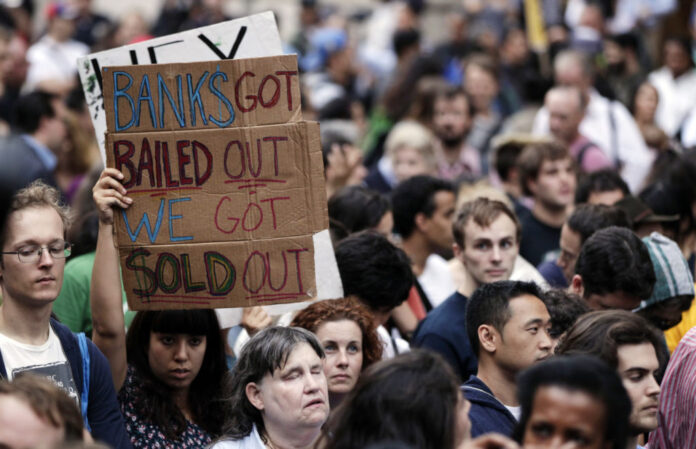
The year 2008 brought a crisis comparable to the Great Depression in 1929. The sudden downturn left millions facing job losses, home foreclosures, and felt they were betrayed. Families, once confident in their financial stability, found themselves in precarious circumstances. Was this widespread hardship simply a consequence of unfortunate economic cycles, or were there deeper, more systemic issues at play?
Background
Usually, when someone wants to buy a house, they get a mortgage from a bank. The bank loans the home-buyer the money that will be used to buy the house, and the home-buyer pays the bank back monthly until the mortgage is paid off plus interest. When the home-buyer is unable to pay off the mortgage, it’s called a default and the bank gains ownership to the house. Typically, the banks wouldn’t give loans to those with bad credit or an unsteady job as that would increase the risk for a default on the house. However, this all changed when the demand for mortgage backed-securities increased.
Mortgage backed-securities was a way that investors would invest in the housing market. The securities were created when large financial institutions securitize mortgages by buying individual mortgages and grouping them together. They then sold shares of these pools to investors. The investment was seen as fairly safe with high potential upside, so naturally demand increased. Due to this high demand, banks sought to create more securities by giving more loans to people who would not have previously met the requirements. Along with these subprime mortgages, institutions also used predatory lending practices. This was a practice in which institutions would not even verify the home-buyer’s income.
As investors continued to throw money at the market, housing prices continued to increase. Because the practices that these institutions used such as subprime mortgages were new, they could point to historical data to suggest that mortgage debt was a safe bet. Traders also started investing in CDO (Collateralized Debt Obligations), an even riskier investment. The low requirements and low interest rates drove the housing prices higher, which made these investments seem even better. This led to a phenomenon commonly known as a “bubble.”
The Bursting of the Bubble
As time went on and the subprime homeowners couldn’t pay their mortgages, the houses started to default. As more and more houses began to default, the supply of houses in the market soared as demand was low. The housing market then crashed and in 2008 the housing prices proceeded to crash, ensuing a domino effect. Financial institutions were then unable to account for losses and they began to shut down. The government tried diligently to save companies such as Bear Sterns and Lehman Brothers, but they had dug themselves too deep.
The ripple effects following the burst was intensified by the institutions’ risky and predatory practices. No one suspected a thing since the institutions claimed a very low risk investment. So, countless people pumped money into these investments due to the ignorance of the professionals. The amount of money in the mortgage-backed securities and collateralized debt obligations amplified the event substantially.
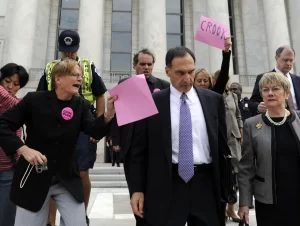
Mass panic ensued and investors rushed to pull their money out of the market. This triggered mass sell-offs and the free fall of the stock market. Some of these institutions’ banks stopped lending, freezing credit and making it impossible to secure a loan. This liquidity crisis rippled through the economy, leading to bankruptcies, mass layoffs, and a deep recession. Public panic intensified as people lost their jobs, homes, and savings, further fueling the economic collapse.
Lasting Effects
The effects of the financial crisis touched just about everyone in America. This period resulted in millions of job losses combined with substantial declines in home values and reduced retirement account balances. The recession ultimately resulted in 8.7 million job losses and six million foreclosures along with a $2.4 trillion loss in retirement accounts.
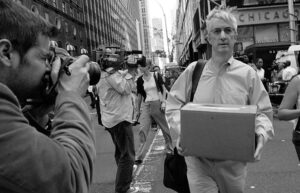
When their institutions faced catastrophic failures, Lehman Brothers’ Head Richard Fuld and Bear Stearns’ Chief James Cayne had already amassed substantial personal fortunes. Between 2000 and 2007, Fuld amassed more than $500 million, while Cayne generated approximately $376 million. Though the financial disaster harmed many financial officials, only some faced legal consequences for their actions. Following the crisis, new regulations emerged to increase oversight of financial institutions. The 2010 Dodd-Frank Act and Consumer Protection Act worked to increase financial disclosure to prevent dangerous speculation while shielding consumers from harm.
Conclusion
The risks of unregulated finance and the consequent threats to overall economic stability were revealed by the crisis of 2008. Despite the ongoing debate on the role of regulation in financial markets, one can argue that the crisis has once again shown that stability and transparency in the banking system are essential. Economic downturns are usually the result of combined systemic factors, market actions, and policy measures. It is possible to reduce the likelihood and impact of future crises through the analysis of such events. It is crucial to remain up to date with regards to financial systems and economic policies in order to be able to comprehend the possible threats and the countermeasures that have been developed.
Tune into The Roundup for more historical coverage!