

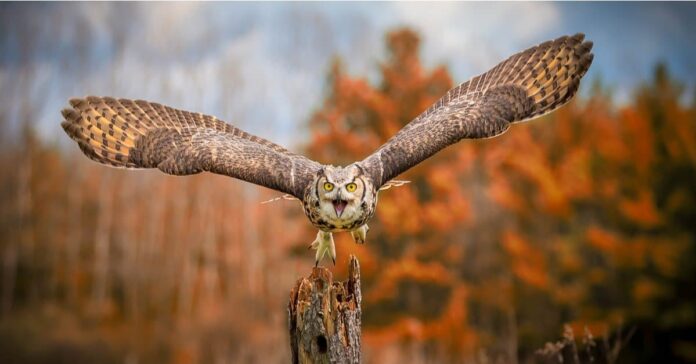
The Great Horned Owl (Bubo virginianus), often heralded as the “tiger of the skies,” is a captivating and formidable bird of prey that has fascinated humans for centuries. With its distinctive ear tufts, which resemble horns, and deep, resonant hooting, this species embodies the mystery and majesty of the nocturnal avian world.
Characteristics:
The Great Horned Owl has many characteristics which contribute to its majesty. Firstly, they are somewhat large owls with a robust build, most notably featuring prominent ear tufts that resemble horns, which contribute to their name. Their feathers are a mix of browns, blacks, and whites, providing excellent camouflage against tree bark. Along with their extremely effective camouflage, these animals are equipped with striking yellow eyes are not only mesmerizing but are also adapted for exceptional night vision, enabling them to spot prey in low-light conditions. These tools, complimented by a large beak and large wingspan, make Great Horned Owls an apex predator in their wooded environments.
Ecology:

The Great Horned Owl’s ecological role is multifaceted, reflecting its status as a top-tier predator within its environment. This owl’s diet is remarkably diverse, encompassing a broad spectrum of prey including mammals, birds, fish, and even reptiles, which underscores its adaptability and the vital role it plays in regulating various prey populations. By controlling the numbers of rodents and other small mammals, Great Horned Owls contribute to limiting the spread of diseases and agricultural damage, thus demonstrating a direct benefit to human interests as well. Their territorial nature and wide-ranging habitats, which span from the Arctic tundra of North America to the tropical rainforests of South America, showcase the species’ exceptional adaptability to different environmental conditions.
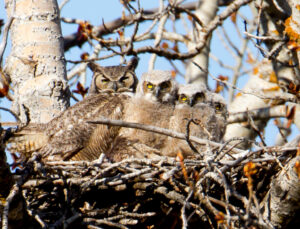
The Great Horned Owl’s nesting practices further illustrate its ecological adaptability. Rather than constructing its own nests, it often takes over the abandoned nests of other large birds or utilizes natural cavities in trees, cliffs, and even human-made structures. This behavior indicates a certain ecological opportunism, allowing them to thrive in varied ecosystems. The presence of Great Horned Owls within an ecosystem can also serve as an indicator of ecological health, as their survival and reproduction are closely linked to the availability of suitable habitats and abundant prey. Consequently, the Great Horned Owl not only plays a critical role in the balance of food webs by managing prey populations but also contributes to the biodiversity and health of its habitat, embodying the interconnectedness of ecological communities.
Fun Facts:
- While not exclusive to the Great Horned Owl, the species as a whole consumes prey whole, and coughs up excess indigestible material as pellets
- The ‘horns’ are known as ear tufts, although they don’t have anything to do with hearing; they help camouflage the owl among the trees.
- Owls use the 14 vertebrae in their neck to move their heads270 degrees to look in different directions.
- Due to a poor sense of smell, they are one of few animals to include skunks in their regular diet.
- Their sense of hearing is so acute that they can detect a mouse stepping on a twig from a distance of 75 feet!