


As a graduated senior of the Class of 2026, I wanted to use my experience from my four years at Jesuit to give advice to the incoming freshman class.
1) Join as Many Clubs as Possible
During my four years at Jesuit, I have participated in many clubs, such as Model UN, Medical Society, and Multicultural Society, but I wish that I had joined even more during my earlier years.
First off, although students can be busy with sports and other extracurricular activities outside of school, there is always time for clubs! Jesuit gives us the opportunity to meet with clubs during Community Time, a designated block of free time from around 2:00 to 2:30. Clubs usually meet once a week, so they choose one of the five school-day community time periods to meet. That means that as long as your club meetings don’t coincide with each other, in one week you can engage with multiple clubs. Even better, this is all done during school, so if you don’t have time before or after school, you can still be involved!
Secondly, joining clubs in your earlier years can open the door to leadership opportunities. For instance, if you join a club your freshman year, and stick all the way up into your senior year while actively participating, you might have the chance to be elected president of the club. Leadership experience is a valuable trait that we should all learn for the real world, so, by leading a club, not only are you stepping up to lead the way for others in the club, but you’re also doing yourself a great service.
You may ask: what do you do if you want to join a certain club, but that club does not exist? In that case, you could start one. Sophomores and upperclassmen are allowed to start their own clubs (freshmen cannot). So, if you’re a freshman and want to start a club, you’re going to have to wait a year. But in the meantime, you can start preparing to create one. In order to create a club, you need a certain number of signatures showing that your club will have the required minimum number of members, and a moderator (which has to be a Jesuit staff member). I highly recommend starting your own club so that you can add to the diversity of clubs that we have at Jesuit.
Lastly, clubs are great if you want to socialize. Clubs are an easy way to make friends not only with your classmates, but also with the upperclassmen, allowing you to build your Jesuit brotherhood.

2) Meet with Teachers
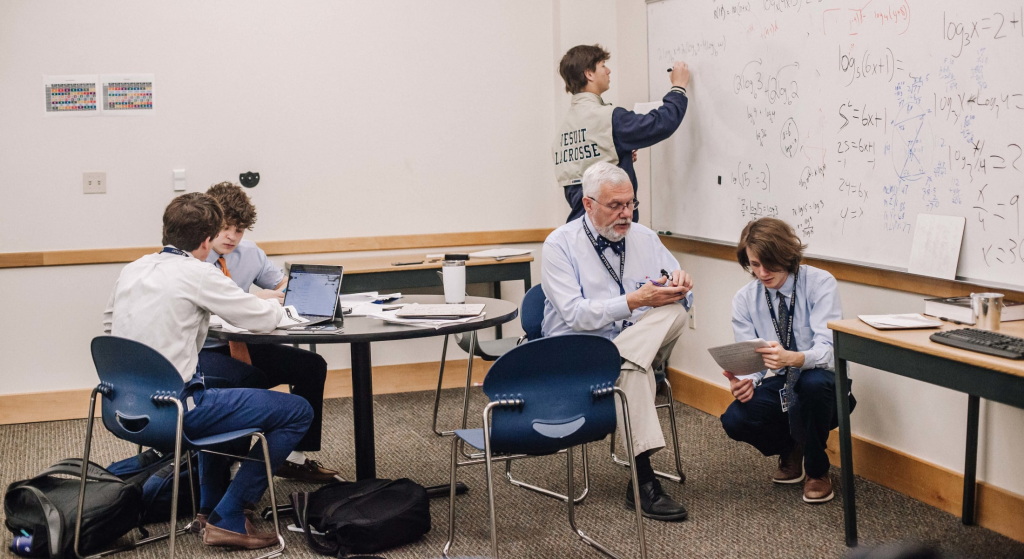
Between freshman year and sophomore year, I made a great improvement in my grades. The biggest factor was meeting with teachers. Classes can be overwhelming. We might procrastinate, fall behind, or fail to understand why we did not do as well as we wanted to do on a test. One of the easiest ways to fix all of these issues is to meet with your teachers. For instance, in sophomore year during AP World History, we had an LEQ, and I missed the “introduction” point on my essay. I decided to meet with my teacher for about 15 minutes, and after that meeting, I always earned that point on my essays. You can also meet with teachers about stuff other than tests, like if you fall behind on a unit. Last year I took AP Chemistry, a really fast-paced class, and I fell ill for a few days, so I missed class and was really behind. I tried to learn some of the unit on my own and was very confused on the rest, so I met with my AP Chemistry teacher, and after one meeting of sorting things out, I felt confident in my understanding in that unit.
You don’t have to limit meeting with teachers to just your teachers either. Every day, there are math teachers in the Math Lab, and you can just go there to ask for help on math questions. But here’s one thing you need to do if you do book a meeting with your teacher: make sure that you show up. I remember that in sophomore year in English class I would always book revision meetings with my English teacher after school, and although I made some really great improvement, there were still a couple of times that I accidentally missed the meetings. For my teacher, if you missed three meetings, for the next two weeks you couldn’t book a meeting and would just have to drop by if there’s an open spot, so remember to stick with it if you commit to it.
One might ask “can’t I just watch YouTube videos to learn instead of meeting with teachers?” As someone who has done that in the past, I can say that meeting with teachers is far more efficient. At the end of the day, teachers want you to do well in their classes, so remember to take advantage of that: show up to the office hours, the review sessions for a test before school, and English revision conferences.
3) Drive to School
Upperclassmen (juniors and seniors) are allowed to drive to school with designated parking spaces. Juniors have to park in the Anderson lot, right next to school, and seniors get the Senior Lot, on campus. As a senior, driving to school is really convenient. When I arrive and park, all I have to do is take a 3-minute walk to class. However, the Anderson Lot is further, so expect around 10 minutes to get to class. I live in Plano, so in the mornings the drive is around half an hour, and after school due to rush hour it’s a bit longer. Driving can be a bit challenging at times because of the distance, but having the autonomy to drive instead of being picked up/dropped off by a parent is definitely the better choice. I didn’t drive to school as a sophomore, and I remember that I would have to coordinate with my parents about when to pick me up and would spend some time waiting after school because I was waiting for my ride. When you drive to school, you don’t have to worry about all of that, and you are saving your parents the hassle of leaving work and waiting in traffic to pick you up. I strongly recommend driving to school when you become a junior if you have the chance to.
As a senior, our Wednesday service sites can be quite far from school (mine is 20 to 30 minutes). Since the drive can be quite lengthy, it’s definitely easier to drive yourself there instead of being dropped off. Plus, with Senior Release, you get to leave school early if you have a free period, so instead of waiting for a parent to get off work and then pick you up, you can leave school a couple hours early.
Now, how do you get a parking pass? Well, around the end of each year you can apply for a parking pass. The requirements are that you have a license and pay the fee for a spot. Something to keep in mind is that if you have a sibling, you are encouraged to carpool, since that takes up less space and minimizes the amount of traffic that we get in the school during morning and after school hours. So, once the parking passes become available, try to get one. Also, try to carpool with a sibling.
4) Try Out New Things
You should branch out and step out of your comfort zone. Since freshman year, I’ve played water polo, but towards the end of my sophomore year, I realized that I wasn’t too good at it, so I decided to try a new sport instead. I ended up taking up Taekwondo, and that was a great choice. Sure, I started Taekwondo as a 16-year-old, which is quite late compared to the majority of practitioners, but through hard work I ended up doing well in it. If it weren’t for my mindset to “get out of my comfort zone,” I wouldn’t have made that significant decision to try a new sport which I ended up excelling in. This is why I encourage you to try new things, whether it be sports, or even classes. My freshman year, my classes were mainly regular classes, with only one honors class. During sophomore year I stepped it up and took mostly honors and AP classes. I ended up getting straight A’s that year. If it weren’t for me stepping out of my comfort zone, then I would have never known my academic potential.
By staying in your comfort zone, you’re limiting yourself and holding yourself back from being as great as you could be. This concept of “trying out new things” ties into the other topics that I have talked about, whether it be checking out that new club, meeting with a teacher about a class, or getting your license in order to drive to school.
5) Do Your Homework
One thing that I really want to emphasize is homework. At Jesuit, almost all the classes have a category called “work habits.” You get points in that category based on turning in class work on time but mostly turning in homework on time. They usually make up 10% of your grade, so even though it might seem like it has minimal impact, it actually has a lot of impact. For example, if someone has a 100 in the test category but a 0 in work habits, they will get a 90 in the class.
So, homework can significantly impact your grade as it’s the difference between an A- or an A+. As a senior who has experienced both the negative and positive effects of homework because of work habits, I suggest that you do all of your homework on time. But most importantly, work habits aside, doing your homework keeps you on track and helps you not fall behind, helping you do well in the class overall.
6) Be an Active Member of the Community
The last topic that I want to discuss is engaging with the school during events. For every class year, there is a retreat held (Freshman Retreat, Sophomore Retreat, Junior Retreat, and Senior Retreat). These retreats are contemplative, and they’re held in groups. There is discussion, reflection, and some quiet time. In my opinion, each year the retreat gets more immersive. You go from being in groups split up into classrooms in the school freshman year to going to a retreat center miles away from Jesuit during Senior Retreat, otherwise known as “Kairos.” In my opinion, Kairos is the most impactful because it requires you to reflect on your prior years of Jesuit, and you are immersed in a reflective state of mind. Even though the retreats have a Catholic faith aspect, as a Muslim, I was still able to fully participate. So, even if you are outside of the Catholic faith, don’t worry, because you will still be able to engage with the material in the retreats.
On top of this, service is another way to be involved in the community. Service is a requirement to graduate, so it’s really important that we not only do service but are passionate about it. I was always involved in service when I was younger, so I’ve had a positive outlook on it. I encourage all freshmen to also have a positive outlook on service. Don’t just view it as a “task to do,” but rather as fulfilling your role as a Jesuit student in this world, and your embodiment of Jesuit ideals. This idea of being an active member in the community doesn’t only extend to service and retreats, but to even more events, like participating in the competitions on Ranger Day, or cheering for our school during football games.

Conclusion
These six pieces of advice are the main things that I want to drive home when it comes to giving tips to the underclassmen. This is my way of sharing what I have learned, and I encourage you all to do the same thing when you’re a senior talking to the new freshmen class. It could be an article for The Roundup, or just a chat with an underclassman when you’re walking in the hallway.
Stay tuned to The Roundup for more Student Viewpoints!