
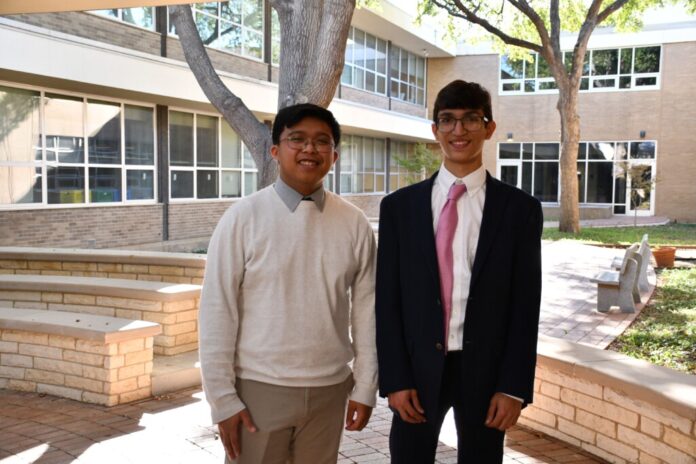
Over the summer, seniors Ryan Virkar and Jon Noquil participated in UT Southwestern’s exclusive STARS program. This eight-week program, a non-residential program provides students the opportunity to work with a faculty host while researching a medical issue.
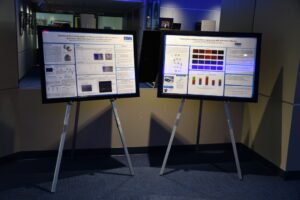
Earlier this semester, Virkar and Noquil presented their research to Jesuit’s Medical Society to help encourage students to participate in the program and learn about their medical research.
Ryan Virkar
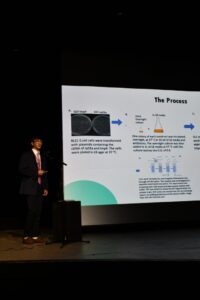
Ryan began his presentation by discussing what the program was like and how the research would run. Ryan’s research was identifying the binding regions of ribosome S3A to Importin-4. The importance of this research is that ribosomes are essential for the human body to function as they create proteins in each cell of the body. For his research, Ryan studied cells and added different solutions to get proteins sticking and having only the Importin-4, which is what he was mainly studying.
Ryan made two different purification systems to isolate the proteins in S3A and Importin-4. The isolation of the proteins helped Ryan locate a trend to find when he successfully isolated Importin-4. For the S3A protein, Ryan isolated the protein differently, but came to the same conclusion that when the trend increases, the protein is successfully isolated. With the isolation results, Ryan continued tests to find out when the proteins bind, making the hypothesis true. To confirm his hypothesis, Ryan tested cloning the DNA of the proteins to find a more precise region where the proteins bonded. Finally, Ryan discussed how the research can be continued by finding and securing a region where S3A and Importin-4 could be bonded in the future. The Roundup asked Mr. Virkar some questions related to his work:
What was your most favorite aspect of the program, and what did it mean to you to be part of the program?
My favorite part of the program was the ability to pursue my own research project and learn from the graduate students and postdocs who are pursuing a career in research. It was an honor to represent Jesuit as part of this program
What was one aspect of your research that was the most interesting to you, and do you think you would want to pursue this career in the future?
I really enjoyed testing the binding of the isolated proteins to have a better understanding of a critical cell function. I am not sure if I want to pursue a career in research but I am definitely interested in pursuing more research in college.
Jon Noquil
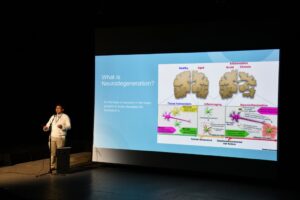
Jon also described his experience of the STARS program and highlighted the communal aspect of working with many people that many other places may not do as much. Jon’s research focused on viewing neurodegeneration in aging mice with Alzheimer’s disease. Neurodegeneration is the loss of neurons in the brain which happens with Alzheimer’s disease. Jon began the talk with how Alzheimer’s affects millions of people at a young age, and how mice have similar brains to humans.
In his experiment, Jon used mice at different ages with and without the Alzheimer’s gene to see how they acted and what was similar and different with the different groups. After a certain amount of time, Jon cryostats (sliced) the mice’s brain cells to see what their brain activity was like. Then, he would take a long process of dilution where Jon was able to see different parts of the brain with different lights. Furthermore, Jon viewed the brain through a fluorescent microscope to see different parts of the brain. Jon concluded that the general trend was that the mice got older positive cells and neural stem cells in the brain. Finally, in the data collection, Alzheimer’s had an abnormal peak at six months of the data collection, which will be the next step of Jon’s research to figure out why that happens. The Roundup asked Mr. Noquil some questions about his research:
What was your favorite part of the program, and what does it mean to you to be a part of it?
My favorite aspect of the program was the independence granted to me as an intern when it came to conducting my own experiments. The community I was able to build with the other interns attending the STARS program is equally my favorite part of the program. To me, being part of the program was a special honor as it allowed me to explore what I possibly wanted to do in the future and also opened up other possible career paths through the numerous lectures they gave us. In the future, a research career is definitely something that I will consider.
Stay tuned to The Roundup for more news regarding the Jesuit Medical Society!