
“Debate on Draft Resolution 1.3 is now closed. We will now enter voting procedure. Nobody may enter the room, and nobody may leave. Runners, please bar the door. No talking, no passing notes. ”
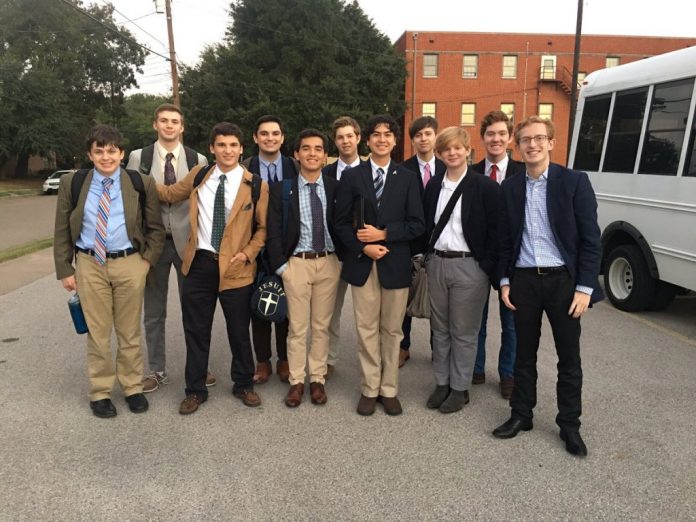
While this may seem to be another step in stodgy bureaucracy, it is actually the culmination of several hours of debate, discussion, and compromise. Eight hours earlier, hundreds of high school students, including ten from Jesuit, milled about in Baylor University’s chapel. Passing through the room, you would hear dozens of excited discussions about narcotics, nuclear disarmament, and the growing threat of climate change. After a few opening remarks by Baylor staff, the mass of students split into fifteen subgroups of around thirty students each, and the true events of the day began.
At Baylor University’s annual High School Model United Nations conference, students from all across Texas convene to debate issues long thought to be resolved. These issues are debated through mimicking the actual United Nations and utilizing all parliamentary procedure associated with it. After being assigned a sub-conference, or issue to discuss, each delegation is also assigned a country to represent.
Going into a conference, a delegate’s goal is three-pronged: to advance their own country’s interests, to subvert those of their enemies, and to do so democratically. For example, in a simulation of the 1994 Security Council on Rwanda, the goal of Rwanda’s delegation is to obtain as much humanitarian aid and military support as possible. In the 1995 Security Council on Iraq, it is Iraq’s goals to avoid as many sanctions as possible and to remove sanctions already in place.
In order to advance such varied goals, delegates have two tools: their wits and their vote. After the moderator calls the session to order, delegates launch into formal speeches. For approximately half an hour, various delegates with strong interests in the matter at hand present their positions while those not speaking take notes and form tentative alliances. Once no delegate wishes to speak, the session traditionally moves into the largest section of the day: the uncontrolled caucus.
Unlike during the moderated caucus, delegates are free to move about the room and discuss, plot, and draft resolutions. Over the course of a day, alliances will break, coalitions will fracture, and each delegate will be forced to compromise again and again in order to achieve their goals. In order to encourage stimulating discussion, the chair periodically introduces new information that splits the session from the course of history. Jared Butler ’18 recalls the the apprehension of receiving new information: “Receiving a wire always carried with it an anxious tension … [because] some sort of outside event could emerge that might derail hours of work.” These arbitrary setbacks force delegates into improbable circumstances that require quick thinking and further test a delegate’s political tact and ability to compromise.
After hours of diplomatic trials and tribulations, delegates break away from their coalitions to cast their ballots. By show of placards, many resolutions crumble, and only a chosen few drafts manage to gather the widespread support required to achieve ratification.
Even though some Jesuit delegates failed to achieve their country’s goals, the atmosphere of the bus ride home was still upbeat. Butler, despite having been foiled by a single vote, fondly looks back on his conference:”In the end, I resigned myself to the fact that Russia’s veto was an inevitability that any of coaxing would only have put off for a small time longer. Though our proposals failed, I was satisfied with the work we’d accomplished. ” Matthew Clayton ’17 shares a similar experience: “Regardless [of our failure], I felt a sentiment of pride that my constituents and I were able to create controversy.”
The Jesuit Model United Nations club meets Mondays after school in B113. In the wake of success at Baylor, the club has set its sights on a spring conference in Houston. Clayton, president of the club, encourages all students who “love to argue” to join Model UN.