

Wheels screech into the pit as the vehicle careens off the track after zooming through its last lap. The coach smoothly advises the driver as the pit crew huddles over the chassis. The pit boss hands a grunt a new replacement part as sounds of rivets crushing and drills turning dominate the background noise. As the last rivet popped, the crew unfolded its tight formation in unison, as if repelled by the vehicle. No, this is not a scene from Speed Racer or Texas Motor Speedway. Instead, it is a typical sight during a 2-day weekend robotics competition like the ones in which Jesuit Robotics has been competing over the last few weeks.
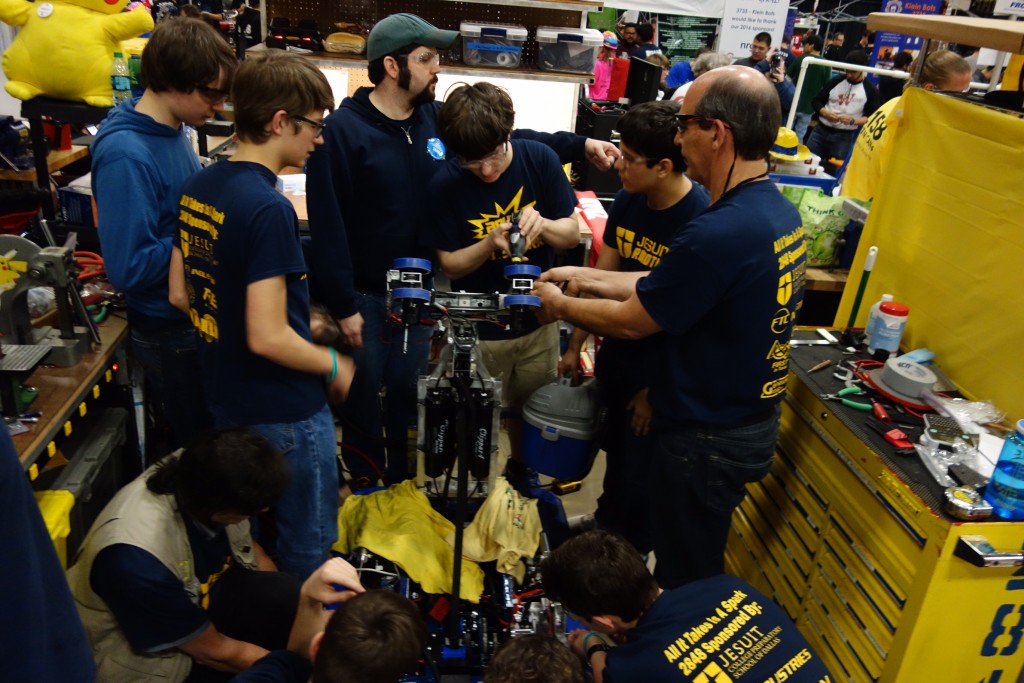
If you’ve been following along with Jesuit Robotics updates, you might think that all the team’s efforts to create their robot were finished in the lab when the robot went into “the bag.” However, what you might not realize is that’s only half of the race. The other half is driving, bending, breaking, and fixing the robot at the competition.
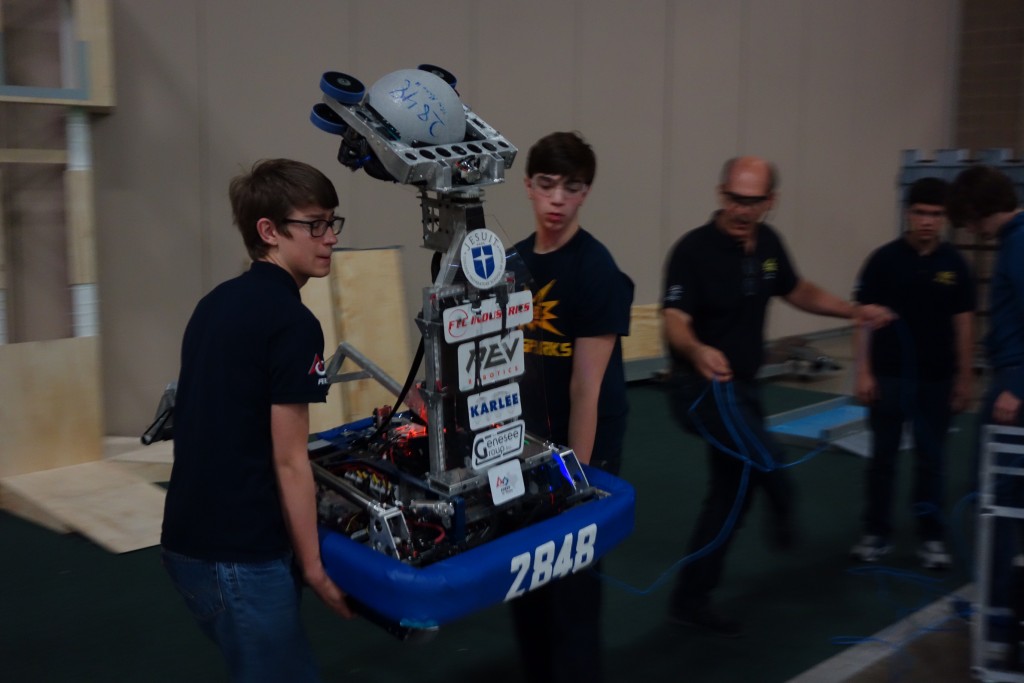
Over Spring Break three weeks ago, Team 2848 traveled to and competed at the Alamo Regional in San Antonio. After all of the unloading and unpacking from the trailer, the small 10-foot by 10-foot space called “The Pit” was transformed into a mobile outpost of our shop under the Terry Center, outfitted with everything required to fix a robot. The team needed it. Even after the first few matches the once pristine robot was dented and bent in a few critical areas, such as the shooter-carrying arm and its ball intake bar. Pit boss Spencer Gautreaux “discovered new problems each match,” dealing with “the robot bending in numerous places.” His central role was pivotal in a regional competition that demanded focus from the pit crew. Despite the bends on the robot making it hard for the programmers to adapt the auto-tracking code used to align the shooter with the goal, the drive team made it work, accumulating 19 ranking points during their 8 qualification matches across Friday’s and Saturday’s matches. Entering the elimination rounds with a record of 6-2, the pit attendees and drivers were exhausted but ready for more. After the majority of the team spent time scouting matches in the stands, a large quantity of scouting data was amassed, allowing the team to decide who to pick in the upcoming draft. At the eighth and final seed, the Jesuit All Sparks chose Team 1255 (the Blarglefish) and Team 457 (the Grease Monkeys). In the upcoming three matches, this eighth seed alliance fought hard against the first seed alliance but came up short with two losses and one uncounted match due to problems with the playing field.
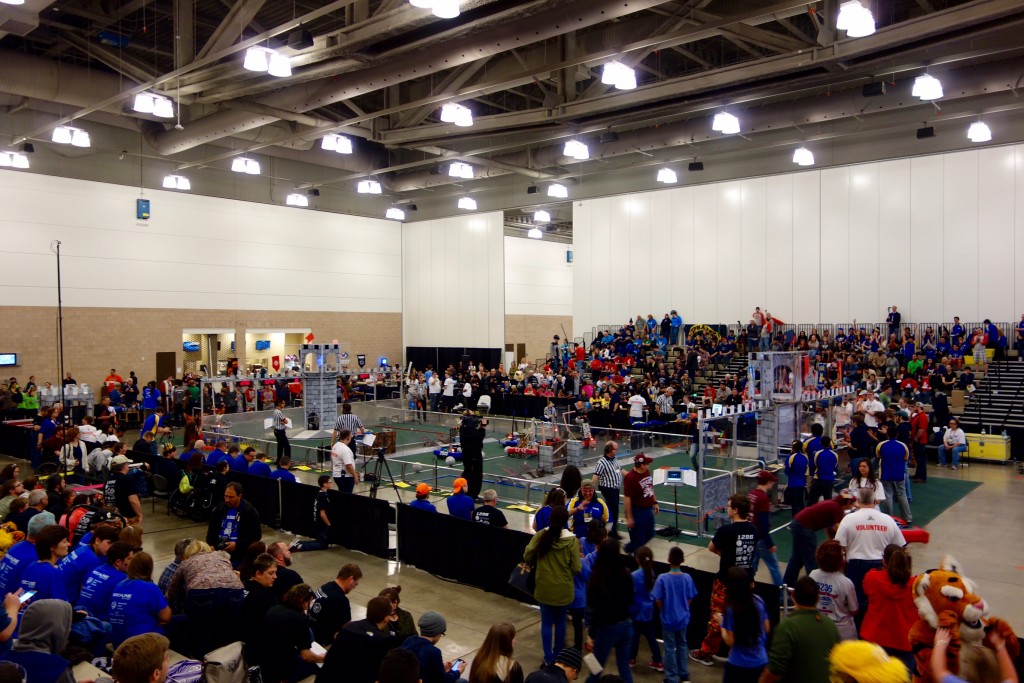
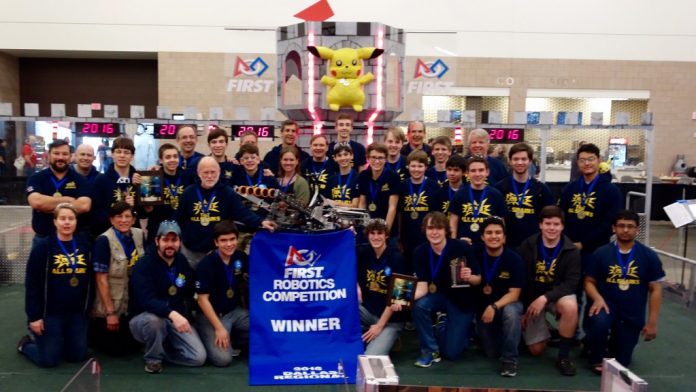
Two weeks later, things were looking much better for the team on their way to the Dallas regional because of their improvements to their robot, “Grover.” The team decided to take off the shooter arm and the intake mechanism, replacing them with an improved intake design and a more reliable high goal-shooting catapult. This new and improved “Super Grover” could pump balls into the high goal much faster than Grover could, and, after a little practice, the drivers felt better about their chances. Able to translate his previous experience to Dallas, Sophomore driver Jack Barone “learned how to come up with quick solutions to the problems that arose when things didn’t go as planned” in the Alamo regional. With improvements in driver confidence and robot robustness, the team was excited and ready to go. This time, 2848 boasted 33 ranking points over a 10-1 record during quals, with only a few scratches to show for it. Entering eliminations, the team was the first seed in the competition. After picking Team 148 (the Robowranglers) and Team 5057 (the Robobusters), the alliance captain 2848 led the trio to the finals in a breeze. Without losing a single match in eliminations, 2848, 148, and 5057 won the Dallas regional, sending each team to the World Championship in St. Louis.
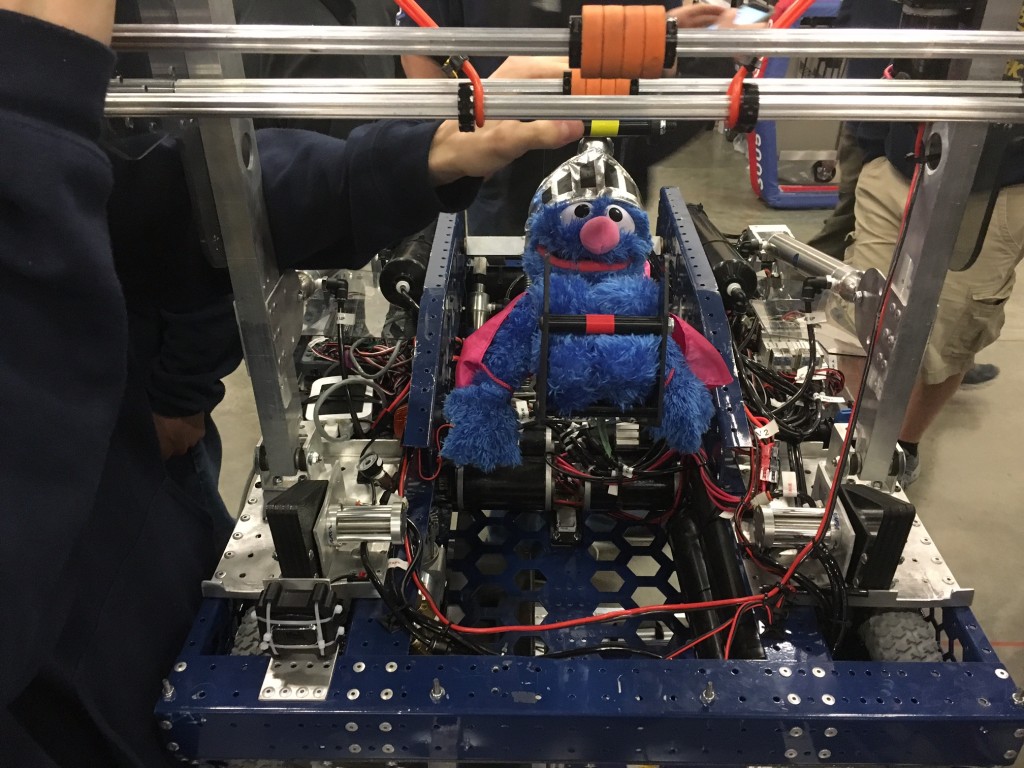
Team 2848’s regular season was a huge success, and it demonstrated the team’s determination to bounce back after learning from their past mistakes. In fact, the team has never won a regional as the alliance captain in its history, dating back to 2009. In the weeks following the success of the Dallas regional, the team will continue to tweak the robot until it is in its best shape for its trip to St. Louis, hopefully becoming Uber Grover in time to bring home another world championship.
2848 Robotics takes on San Antonio and Dallas Competitions
-
Categories
Robotics