
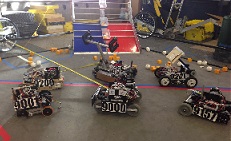
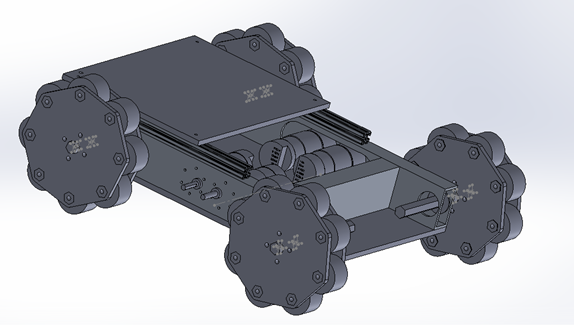
The robot, carried by its specially fabricated wheels, drives against the unrelenting mountain, struggling to climb. A T-shaped robotic arm swings down using gears to carefully lower it into position. The team manipulating its controls, the robot triggers switches on the side of the mountain to gain points. In the hectic last 30 seconds, the robot swiftly maneuvers its arm up to pull itself into the next scoring zone. By the end of the match, the score is 100 to 85. Each FIRST Tech Challenge competitor faces the same tough terrain in every two-minute match.
FIRST (For Inspiration and Recognition of Science and Technology) is a robotics organization where thousands of teams nationally compete in their FTC (FIRST Tech Challenge) and FRC (FIRST Robotics Challenge) competitions to prove their robot’s superiority. The Jesuit robotics program added the FTC program to its schedule last year and came back with six teams this year. Jesuit students work in teams to design and fabricate their own unique robots in their shop. They have the unique opportunity to use industrial equipment, like lathes, mills, a laser cutter, and a plasma cutter, many of which other FTC teams only dream of having access to. This means that the students can dream big and learn how to transform ideas into tangible progress. This year, the challenge mirrors a realistic situation that can be aided by robots, demanding innovative ways to rescue people and clear debris from a mountain catastrophe.
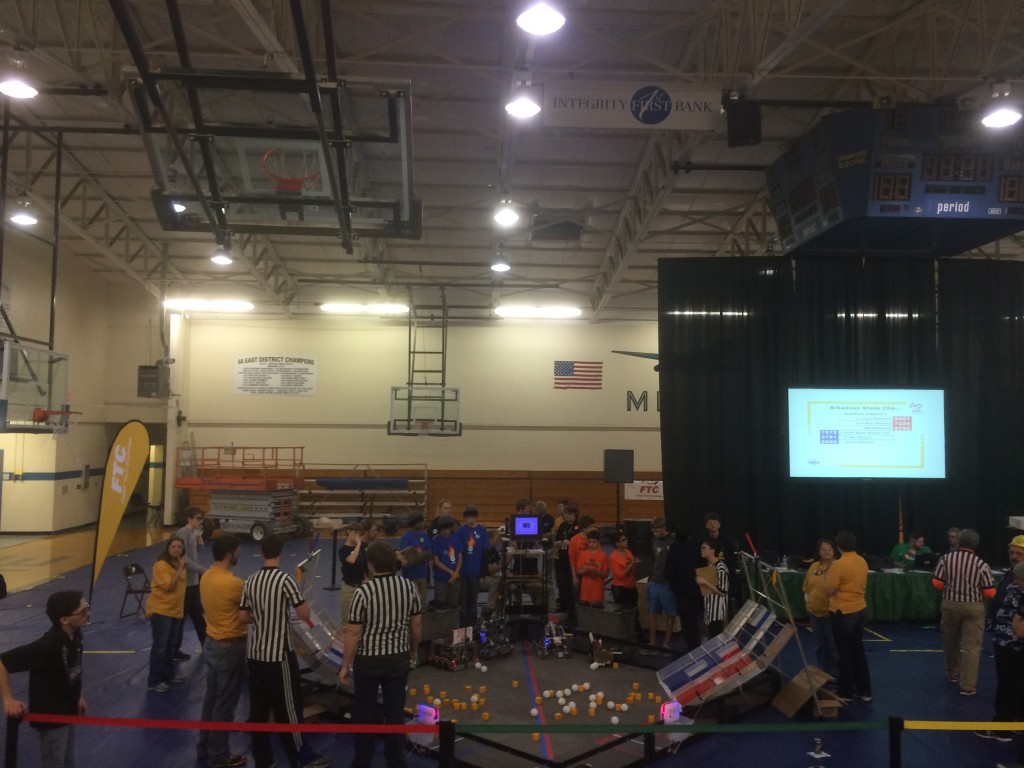
Last Friday, the six Jesuit teams embarked on a journey to Mountain Home, Arkansas to compete against teams from across the country. Mr. Wester graciously sacrificed eight hours of his life to drive the first leg of the tiring road trip, a drive filled with commotion and pre-competition jitters. Noah Santoni, a freshman member of one of the teams, commented that he “was nervous, but it was a nervous excitement” because of his confidence in his team’s robot. Although the feeling of traveling hundreds of miles only to compete at a small middle school felt a little awkward, the teams were surprised by the bustling energy of the other 29 teams upon arrival in “the pit,” the area for last minute touch-ups and robot repairs.
Saturday morning, teams frantically prepared their robots after the first round of inspections the night before. Each with their own strengths and weaknesses, the robots represented a wide range of ideas, yet a few linking ideas connected many of them into the Jesuit family of robots. For example, one team thought of using a tape measure to extend and retract the strong metal tape, fashioning a hook at the end of it to help their robot climb the mountain. Several of the teams used this idea on their own robots, significantly improving their climbing capabilities. After teams were judged based on their work leading up to the competition as well as the final product, competition commenced, consisting of two randomly paired allies competing against another alliance. This aspect to the game adds another layer of difficulty: not only do team members have to work together in their own team, but they also must collaborate with allies to maximize their scoring. In addition, teams had to deal with issues with their own robots, such as programming failures and mechanisms breaking. Adam Kissee, a junior member of one team, had a challenging day, dealing with “problems that arose with [their] robot’s control system acting up.” Handling one challenge after the other, the Jesuit teams battled their way through five games, with four of the six making the elimination rounds and team 9000, led by sophomore Jack Barone, making it to the finals.
Overall, Jesuit showcased both ingenuity and improvement in teamwork and leadership skills. Now many members will move on to the more intense FIRST Robotics Competition, the competition that Jesuit won in 2014, which crowned them “World Champions.” On the way back home, Jesuit began to strategize for the upcoming season, wanting to improve, even after months of hard work on the FTC robots.
If you are interested, here is the kickoff video for this year’s Res-Q competition: