

The sleek, still, shining, shimmering silver exteriors of the tall, glimmering buildings hide the countless activities inside as medical students and researchers go about their everyday business– studying, attending lectures, and working in labs. The food court teems with life as students purchase a snack from a vending machine or buy a fresh cooked meal from one of the countless restaurants. In the labs, researchers conjecture, perform tests and study the results. There’s just one thing out of place: a group of teenagers wearing ties and all kinds of wacky blazers walking through the halls. That’s right, the Jesuit guys have rolled into town.
On November 14th, Mrs. Julie Carver’s Physics and Engineering classes visited the University of Texas Southwestern Medical Center to learn more about health and the role of technology in medical practice and research. In this elite medical school and top-notch research facility, they attended presentations and demonstrations put on by physicians and PhD candidates currently studying at the school.
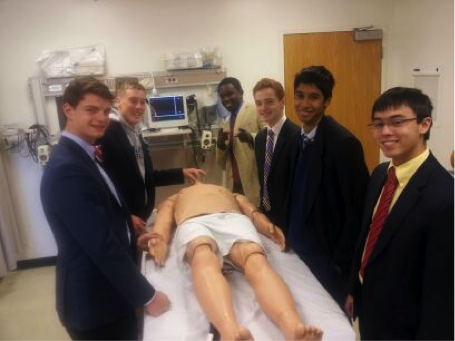
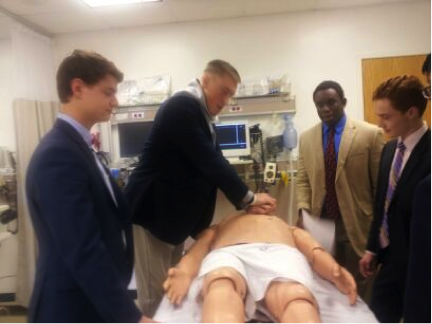 The most popular presentation was an interactive demonstration of medical technology. They split into two groups, as the demonstration room could only hold about ten people at a time. This provided one group a chance to sit and relax while the other experienced the demonstration. Upon entering the room, Matthew Miller’15 noticed that “the room had a much different layout than the previous one. Instead of being a classroom, it looked like a hospital room. It even had beds with dummies in them.” However, dummies might no be the ideal word to describe these mannequins. “They were incredibly complex. They mimicked almost everything a real patient would do. The dummies breathed, had a pulse in all of the major places, blinked, and everything. they sent outputs to monitors and even spoke.” That’s right, the mannequins talk, which was an important part of the simulation that was about to take place.
“Everyone crowded around the mannequin to feel it’s changing pulse, and we learned what to do when various things with the heart went wrong,” Miller summed up. After this quick lesson, the group was divided in half yet again, with one part remaining next to the mannequin and the other heading behind the two-way mirror. Behind the glass, the students observed the other group through cameras located in and around the mannequin, and even provided the voice for an emergency room scenario. “It was pretty cool how one moment we were learning what to do in case of cardiac arrest, and the next we were deciding what we had to do to save a dying patient” remarked Miller.
Apart from the simulation that they participated in, the students also attended two lecture presentations. When they arrived at the school, they went straight from the bus to the classroom for the first presentation: the effect of diet and smoking on health, given by a local health and nutrition adviser. “There were some pretty neat visuals that showed how much sugar we actually eat everyday. And then we had a nice conversation about milk” Miller recalled, laughing.
Afterward, many of the students discussed the presentation, talking about what they liked and disliked about it. They could only relax for a few minutes, for the time soon came for the second and final presentation. A lone picture of a mouse occupied the projector. The speaker introduced himself as a student studying for his PhD and a lab researcher. As it turns out, lab research was the topic. He elaborated on the connection between common lab animals, such as fruit flies and mice, and humans, and how studying diseases and mutations in the animals corresponds with similar diseases and mutations in humans. A question and answer session followed, covering topics from life as a PhD student to diseases currently being studied at UT Southwestern.
It was an action packed day, with the only respite being a lunch break between presentations. “Overall, it was a pretty fun day. I learned about all kinds of interesting things. and it was really cool to see how lab research affects medicines and how we treat diseases.” Miller had one more thing to add: “The most surprising thing I learned today was how much it costs to replace one of those dummies. My recommendation? Don’t do it.”