

What do Demarco Murray, Dirk Nowitzki, and Colby Lewis have in common? They are each professional athletes with injuries preventing them from competing in their respective sports.
What separates these athletes besides their differing sports is their individual injury – Dirk’s knee, Demarco’s foot and Colby’s elbow. Is the fact that each player has a very different injury an indication that each sport has a different set of common maladies? Or, is this just a coincidence?
According to Coach Martin, Jesuit’s Head Trainer, this is no coincidence. He says that high school football players most often suffer head injuries more often than basketball or baseball players. Basketball players are more likely to suffer foot or ankle injuries, and baseball players experience more elbow and shoulder injuries.
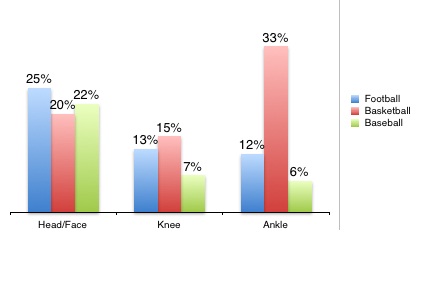
The statistics that Coach Martin generously provided from the 2011-2012 National High School Injury Surveillance Study Summary Report indicate that almost 25% of football injuries are classified as “head/face/concussions.” According to the same study, a third of basketball injuries are ankle-related and almost 20% are caused to the face. The report also reveals that baseball players suffer 20% of their injuries to the head or face, yet about a third of their injuries are to their arms, elbows, or shoulders.
Table 1 – Top 3 Football Injuries compared to Basketball, Baseball
2011-2012 National High School Injury Surveillance Study Summary Report
However, professional sports injury statistics reveal surprisingly different percentages. According to research done for the NFL Players Association in 2010, the top 3 injuries are to the hip/thigh/leg (23%), knee (18%) and ankle/foot (16%).
While head injuries are not in the top 3, they represent 10% of reported NFL player injuries but can be the most serious of these injuries. Coach Martin attributes the smaller percentage of concussions in the NFL to the fact that adults with fully developed brains and stronger necks are not as susceptible to head injuries as the still growing teenagers.
In addition the general demands of each sport place different stress on different muscles. For example a offensive linemen in football uses completely different muscles in blocking, using a combination of quick feet along with sound use of hands, than a basketball player shooting a free throw, using mostly his upper body to hoist the ball up. Additionally within each sport different positions demand different stress on the body than other positions. For example, the motion that a baseball pitcher exerts is much more likely to pose harmful stress on the arm, shoulder, and elbow than any other position in sports. Research reported in the American Journal of Sports Medicine in 2011 found that pitchers sustain twice as many upper body injuries (67% of their injuries) than fielders (32%).
In addition to the obvious health impact, injuries in professional sports are bad for business, too. With the salaries paid to pro players, any time out is an issue for the team and its overall performance. According to the NFLPA data, there is a 6.1% chance for a given player to sustain an injury in any given game and that over 50% of players have sustained at least one injury. Think of it this way: if one of the favorite players of our Jesuit football Rangers were unable to perform on game day, we may experience a smaller influx of spectators that crave action from our elite prospects.
While it is apparent that each sport has its most common injuries, Coach Martin offers some general advice for injury prevention. While no football helmet can fully protect a player from concussion, a stronger neck can help absorb the shock of a brutal hit to prevent the whiplash effect – the most detrimental motion to the brain.
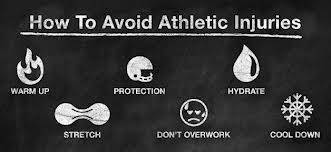
In addition to rest, recovery, and consistent nutrition, Coach Martin advises to always begin any workout with a dynamic warm up, and end with a cool down to prevent muscle tightness and cramps. Also, proper technique when throwing, lifting, or hitting can prevent stress on certain bodily regions that need to remain in optimal conditions during adolescents’ physical maturation processes, especially.