

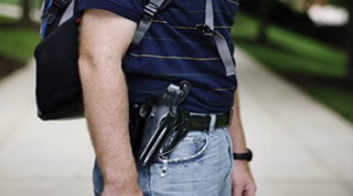
Controversy continues in the Texas State Legislature, the assembly burdened with a decision that will allow both professors and students to carry firearms on college campuses in Texas.
The issue is a legislative response to campus attacks, most memorably the Virginia Tech massacre of 2007. But many question the practicality of the bill, and ask if arming college students is necessary, or for that matter, safe. But the fact is, legalizing firearms within a “higher education” environment that is so vulnerable to attack is vital to the well-being of the students.
In the most recent attack on a school, a 19 year-old gunman barged into the University of Texas last September. He was armed with an AK-47 assault rifle that he fired into the air and at students before taking his own life in the school library. His malicious rampage was stifled only by the quick arrival of campus police, the only ones close enough to the campus with any sort of protective firearm. Time plays an important role in such situations and as San Antonio Senator Wentworth said, “seconds count and the police are only minutes away.” With this new bill, the response to such an attack would be immediate, limiting the gunman’s opportunities to wreak havoc.
Much of the opposition to the bill comes from the reluctance to arm college students with any sort of lethal weapons. Many think that college students are negligent and too immature to handle such responsibility while surrounded by everyday college issues. Some students agree. Colin Goddard, a survivor of the Virginia Tech Massacre protested the bill, saying, “It was the craziest day of my life with one person walking around with two guns. I can’t even imagine what it would have been like with multiple students and multiple guns.” The bill also would address that issue, ensuring that any student in possession of a firearm on campus must register for a Texas concealed gun license, a process that requires that the recipient be 21, which prevents underclassmen from legally carrying a weapon. This license also demands that the individual undergo a criminal and psychiatric background check, a process that costs up to $100, and a 10 hour course in safe handling. Lastly, the individual finishes the license with a final test at a gun range. This tedious process will limit the number of students with handguns, and ensure that those who possess a license can use a weapon effectively when confronting potential harm.
If students are given permission to bring guns onto a campus, it might also prevent attacks by affecting the motives of a potential attacker. Although the motivation of the killers vary, their means of execution stay quite consistent; most are armed with firearms (54 percent according to FBI investigation) and travel onto the campus (79 percent going on campus), and have the planned intent to kill a predetermined individual or group. As of now, a school acts as an institution that can be easily invaded, and the length of the school day provides an easy window of time for a killer to make a move. The vulnerability of these schools can be countered by having a student body capable of protecting itself, a factor that might cause a killer to think twice before executing an attack.
Providing protection on college campuses is the first step in deterring violence. College students can no longer play the role of a fish in a barrel and hide timidly under overturned tables while some chemically imbalanced psychotic murders innocent students. Texans have for many years abided by concealed gun laws, and proved that they are worthy of handling such a responsibility. When push comes to shove, how much different is a legally concealed gun in a shopping mall than a college campus? The rising number in campus attacks means that now is the time to intervene, and with the right laws in place, it might be the difference between a massacre, and an attempted assault with a deadly weapon.
http://theweek.com/article/index/212366/should-college-kids-in-texas-be-armed-on-campus
http://www.vpr.net/npr/133466058/
http://news.blogs.cnn.com/2011/02/22/texas-weighing-concealed-handguns-on-campus/