


Within the ancient world, the city-state of Athens had two major sources of renown; its democracy, the most prominent in Greece, and the stability of its coinage. The Athenian mint was considered extremely reliable in the ancient world, and its coinage was widely used as a standard of quality.
Imagine, for the purpose of thought, that the mint of Athens has maintained the quality of its coinage for one hundred years. On every coin, the written value is exactly the content of silver within the coin. So synonymous has the coin become with quality, in fact, that a coin bearing the owl of Athens is not even weighed or checked for quality; the owl stamped upon it alone means that the coin is good. Such a symbol has the owl become that people have forgotten the actual silver content of the coin and the reason that the coin is valuable, and simply equate the owl with value. The owl is money; the silver of the coin is not even considered.
Now, there is a new Master of the Mint in Athens, who has the plan to cease minting silver coinage and instead, mint tin coins with the owl stamped upon them. His reasoning is that the owl has become so synonymous with value that the silver content no longer matters; a coin has value because of the owl upon it, not because of its silver content. Of course, this is not entirely incorrect; a small number of tin coins, minted with the owl, would likely have little effect on the trustworthiness of the currency. Yet this is not his plan; uncaring of the value that the owl represents and believing that the owl does not symbolize but equates to value, he plans to double the amount of currency in Athens with tin coins, and believes that he will, in fact, make the city twice as rich for it.

The problem of the mint-master is that he does not understand the concept that a thing can represent a deeper idea without being synonymous. The owl has come to be a synonym with quality because it has been perfectly correlated with quality for a long period. Yet if this correlation is broken, the owl becomes worthless, because its value lies only in its indication of a deeper value.
This reveals a much more broad and general principle:
A symbol of value that has become synonymous with value only remains so as long as its correlation with the forgotten, underlying value remains mostly true. Such a concept can also be applied to the correlation between the documents signifying citizenship and the concept of citizenship.
Defining Citizenship
Full citizenship can be equated to complete and not seriously disputed membership in the nation. The nation may be defined as a group of people who have enough of a degree of “sameness” that they consider themselves the same people (For more detailed outlines of the concepts of ethnocultural and ideological nationalism, see here for the nature of ethnic-national identity in much of the world and here for American national identity).
In other words, true citizenship is to be an undisputed and indistinguishable (not being a member of another nation) member of the political, social, and cultural body, not seen as foreign or of the “Other” in any context. In an ideal world, if we were to blindfold one “ideal citizen” and place him next to another “ideal citizen,” telling each only that the other is a citizen of the same nation, each would know enough about the other from only that information that they would not see each other as a foreigner. Ultimately, what information that would be depends on the nation in question; in Poland it would likely be that the fellow-citizen is an ethnic Pole; in America it could be that both believe in the principles expressed by Paine, Jefferson and Washington. Either way, the information may be generalized to be that said person conforms to the popular and cultural concept of nationality within that particular country.

This is the role of nationalism in a citizen society. Nationalism determines what commonality links the people of a nation. This commonality could be ethnic, cultural, religious, or ideological, yet generally it is historically static. The commonality that defined a nationality at its formation is generally the same thereafter.
Nationalism defines the commonality that forms a nation; citizenship, being equivalent to full and undisputed membership in that nation, can alternatively be defined as the ideal, object, and goal of nationalism. (It must be noted that here, nationalism is not used in the same sense as its modern political usage; in fact, its modern usage maps more closely to jingoism, Nazism, authoritarianism, libertarianism, patriotism, etc., depending on context. It is a quite versatile word in political discourse.)
Through the medium of nationalism, the people of a nationality elevate themselves to the status of citizens, and their government is established for the purpose of certifying citizenship.
The Role of Government
Governments certify citizens; they do not create them. A government can no more state, “fiat civites,” than can the mint-master of Athens create more silver than has been mined. The governmental certification of citizenship is a sign of true citizenship, not citizenship in itself. It is the owl stamped on the coin- it is not the silver. The value of a passport or any other such document lies in that it indicates the presence of a true citizen, not in that whoever is granted one is transformed into a citizen. This is the error of the mint-master. A person who is not a complete member of the social, cultural, and political landscape of a nation is not a citizen regardless of what documents he may bear any more than a tin coin bearing an owl has a silver value.
The people make themselves, collectively, citizens. The government, being of, by, and for the people, is intended to be their organ to maintain the cohesion and identity of the nation by issuing certificates proving valid citizenship so that the people can know who is their own. The silver intrinsically has value; the purpose of the mint is to verify its presence and weight. The mining and striking of new silver does not reduce trust in the coin, just as the addition of persons who fit into the social fabric created by nationalism does not damage a nation. It is the striking of tin labeled as silver that damages the trust.

The Rights of Citizens
The rights of citizens are, in a democratic nation, to vote, to hold office, to serve on juries, and to freely speak their minds. These rights are a direct derivative of true citizenship as defined.
Voting
The right of a citizen to vote is derived from the fact that he is a full member of the nation’s political community. As such, applying the principle that “all men are created equal” (Jefferson), he has the right to an equal say in the affairs of his nation. This right comes not as a grant from his government, but as an organic and logical result of his citizenship.
Holding Office
The right of a citizen to have an office of trust over other citizens is predicated on the concept that a citizen is loyal to his fellow-citizens and can be trusted to govern according to the common principles of his people, putting the interests of his citizens first. This can only be fully expressed by one who is a full member of the social fabric of his nation. Additionally, since he is a full member of society, by the principle of government-by-consent it stands to reason that a full member of society may be granted by his fellow citizens the power necessary to provide them benefit. This right is, again, an organic and logical result of citizenship.
To Serve on the Jury
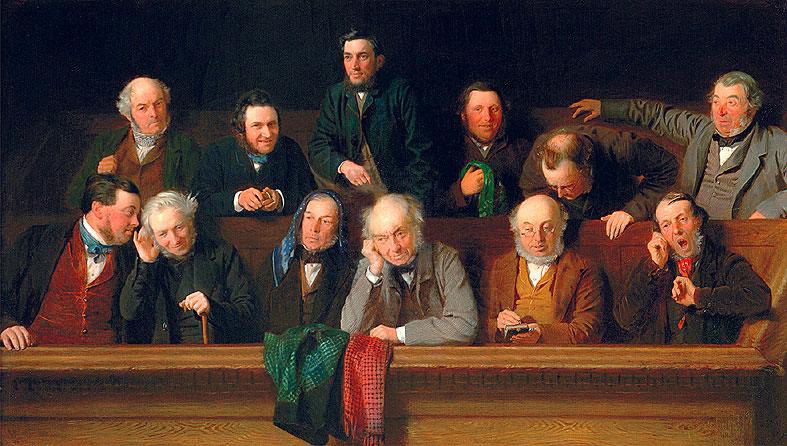
To be a juror is to exercise power over a fellow man, in some cases the power of life and death. The power to determine other men’s fate must necessarily flow from the power of the citizen- applying the principle of government being “of the people, by the people, for the people,” the citizenry is synonymous with governance, it being only logical, then, that the citizenry ought to have a say in the workings of governance (Lincoln).
Free Speech
Free speech is the fundamental right of the citizen. Being a full member of the political community of the nation, it is unjustifiable that another equal member of the political community (since all men are created equal) could possibly have the authority to remove his presence from the national political community. The right to free speech logically flows from the position of the citizen in society.
Fruits of the Ideal System
In the ideal system of citizenship, the government diligently ensures that all citizens are authentically citizens, that they are truly members of the people, and that every citizen can be trusted implicitly as not being a foreign manipulator or one with divided loyalties. The fruits of this are:
- The people trust in their elections; since every vote is cast by a true citizen, there is no cause for a belief that those who ought not to have voted.
- Republicanism thrives; the people believe in their elected citizen representatives, trust that their interest is always put first, and the concept of divided loyalties and foreign puppeteering are alien.
- The people grow neighborly and kind to each other; helping hands are routinely offered, businesses, workers, and customers maintain healthy relationships, and charity and good will are ubiquitous.
- The people are willing to protect each other; in war, the nation is united across all social divisions, and crime is routinely stopped by passers-by. The police are trusted and aided.
- Not being threatening to the nation on account of the government’s actions, foreigners are welcomed as guests; the most talented and best among them are routinely accepted into society, having little to no impact, like one tin coin among a million silver.
Poison of False Citizenship
When the quality of citizenship is not respected, and when the governmental certification of citizenship becomes worthless, society begins to collapse. Here are some of its effects:
- Mistrust in elections abounds; the people, seeing the overissuing of citizenship, begin to believe with lost elections that those who ought not to vote have been, undermining faith in the democratic system.
- Corruption and foreign puppeteering thrive; politicians who are not true citizens have no reason to look after the people, and enrich themselves and foreign nations, as citizens lose trust in their leaders.
- All manners of riots, street violence, and discrimination begin to occur; the people begin violently reacting to being told that those who they know are not citizens in fact are, and in many cases begin scapegoating others who have not even done them harm.
- Coups, civil wars, and revolutions begin to occur as frustration boils over.
- Universal suspicion, loyalty tests, secret police, and McCarthyism become a commonplace feature, as systems testing loyalty break down.
Citizenship is a cornerstone of society. When it is not properly valued, society collapses. Not only do the rights necessary to a democratic society rest on a proper conception of citizenship, the entire structure of civilization itself does also. Whatever may come, it must always be ensured that governmental citizenship aligns as closely as is possible with the historical, cultural and popular definition of citizenship. Otherwise, a democracy will inevitably fall to despotism. After all, order still must be maintained, and the system must continue to function. When the citizen republic no longer values citizenship, it is soon taught to respect the force of a dictator.