


Over a three-day weekend, my family and I traveled to San Antonio to explore the city. The highlight of my trip was learning about the Alamo, one of the most iconic landmarks in Texas history. The Alamo was a Spanish mission for Native American conversion to Christianity when it was first constructed. It was known as Mision San Antonio de Valero, translating in English to the Saint Anthony of Valero Mission. It would later become a Spanish military fort for the Alamo company because of its strategic location. It shifted to Mexican control after the Mexican War of Independence.

Before the Arrival of Santa Ana
The fort was besieged and captured by Texan forces during the Texan Revolution. Despite being understaffed, the Government of Texas could not send more troops to the rebels taking refuge in the Alamo. Due to the inability to defend the point because of the deficiency in soldiers, Texas President Sam Houston sent a small force of soldiers led by James Bowie to dismantle the fortress. Bowie was later convinced that the Alamo should not be destroyed after failed attempts to relocate its artillery. Despite numerous requests for aid, only thirty men led by William Travis and volunteers led by Davy Crockett arrived as reinforcements. Later, Mexican president Antonio Lopez de Santa Anna would arrive in Bexar, his army numbering over 5000 soldiers.

The Beginning of the Siege
The siege began on February 23rd, 1836. Non-combatants loaded into the chapel of the fort while men scrounged for supplies in the surrounding town while they were still able. Santa Ana’s army signified there would be no mercy by raising a red flag, meaning that any man captured as prisoner would be executed. As the siege dragged on, Bowie, one of the highest-ranking officers in the fort, collapsed from illness. Texan soldiers at the Alamo continued to send requests for aid, dispatching couriers with news of the siege in hopes for reinforcements. Colonel James Fannin responded. However, after internal disagreement, he chose to retreat The Texans at the Alamo remained unaware that he would not be coming.
The Surprise Attack
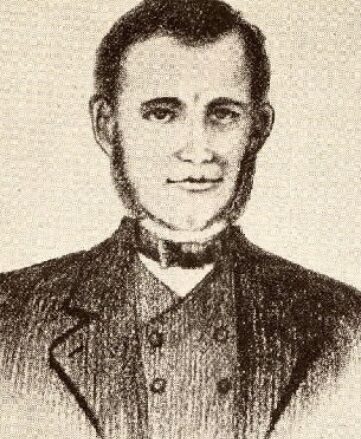
On March 5th, Mexican artillery ceased, and the Texan soldiers in the fort took the opportunity to sleep, however, meanwhile, thousands of Mexican soldiers were preparing for a final surprise attack. In the early morning of the next day, before the Texan soldiers had awoken, Mexican troops silently advanced into musket range of the walls, however they began screaming “Viva Santa Ana” loudly, alerting those inside the fort. The Texan troops were off to an early victory despite the surprise attack and their artillery cannons, which were loaded with just about any metal that could be found as they lacked proper canister shot, proved to be especially effective against the tight concentration of Mexican soldiers. The defenders were overwhelmed by sheer numbers, and according to one account, William Travis was shot and killed while leaning over the mission walls, firing at the soldiers below.
The Breaching of the Walls
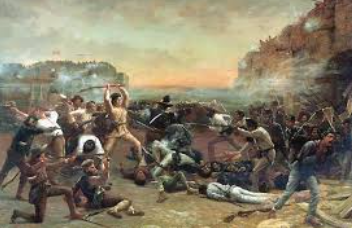
The Mexican troops soon began gathering around the makeshift north wall, climbing up and rushing into the fort. Split between too many targets, the defenders were unable to defend all sides of the walls adequately and began to be overwhelmed, and the battle erupted into violent melee. Though accounts differ, it is said that Bowie died shooting his pistols in his cot as the Mexican soldiers rushed the barracks. Within an hour from when it had begun, the battle of the Alamo was over. Almost all Texan troops who were in the battle were killed in combat, and the few who chose to surrender were quickly executed, as ordered by Santa Ana. All Texan soldiers who were killed had their bodies stacked and burned. The general consensus for Mexican casualties were some four-hundred to six-hundred men.
What the Alamo Means to Me
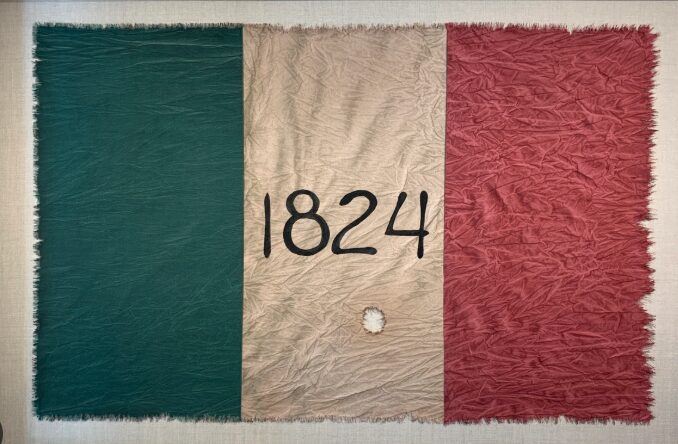
The story of the Alamo is truly a significant inspiration to me. The bravery of the Texan soldiers to not flee or surrender even when faced with impossible odds is something I strive to mirror in my life. All men, Texan and Mexican, fought for a cause that was bigger than themselves and they had the determination to give their life for it. That is why we should all remember the Alamo and those who died that day.
