


In 1980, the Talking Heads, led by singer David Byrne, released one of the best albums of all time, and the second best one of their discography. On that album is their best song, Once in a Lifetime. This song, seemingly meant for CBGB or some other similar dance club in New York, contains a surprisingly deep reflection on life, with Biblical themes weaved within its relatively brief runtime.
The Context
Once in a Lifetime comes off of the fourth album of the Talking Heads discography, Remain In Light. While the title seems to indicate a rather joyful album, the band’s tracks leading up to Once in a Lifetime belie this notion. Paranoia, instability and violence are the feelings of Born Under Punches, Crosseyed and Painless, and The Great Curve, reinforced by confused lyrics and music videos miming various forms of crimes.
The opening notes of Once in a Lifetime serve as an immediate break in the storm. Tina Weymouth’s baseline (written by her husband, drummer Chris Franz who shouted it during a jam session,) puts the listener at ease, already rhythmically establishing the true nature of the song. The bubbly, watery synthesizer repeats its riff, unlike the disjointed and non-rhythmic synth work within the previous three tracks on the album.
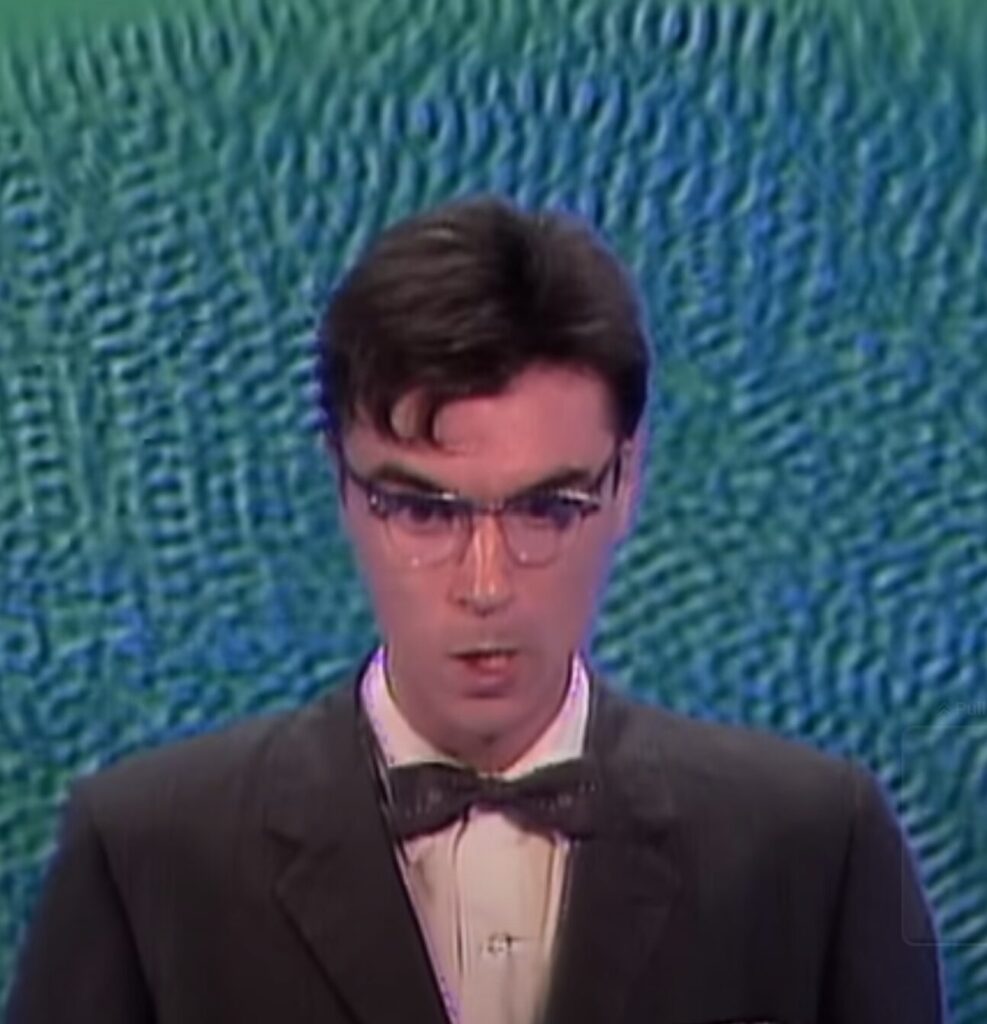
If one watches the music video, this is the moment where Byrne pops out from underneath the frame wearing one of the most iconic outfits in MTV history. It bears mentioning this was one of the first videos MTV had access to and it ran quite frequently. Interestingly enough, Byrne personally worked on the video as a director, ensuring the artistic vision of the video and song perfectly tracked along with editing.
His bizarre costume holds a larger message, evoking the archetypical Protestant Preacher. The big glasses, the look of slight confusion on his face, all give the message of the lyrics- the authority of a preacher, but of one giving his slightly confused first sermon.
Choreography of the Music Video
Byrne looks like he’s having a severe seizure. There’s no way around it, no other way to describe it, and then you pay more attention and realize several copies of him are also having a seizure in the background. However, a bizarre pattern emerges, Byrne is either “walking like an Egyptian” or kneeling down and putting his head onto the floor. These movements are evoking of religious imagery.
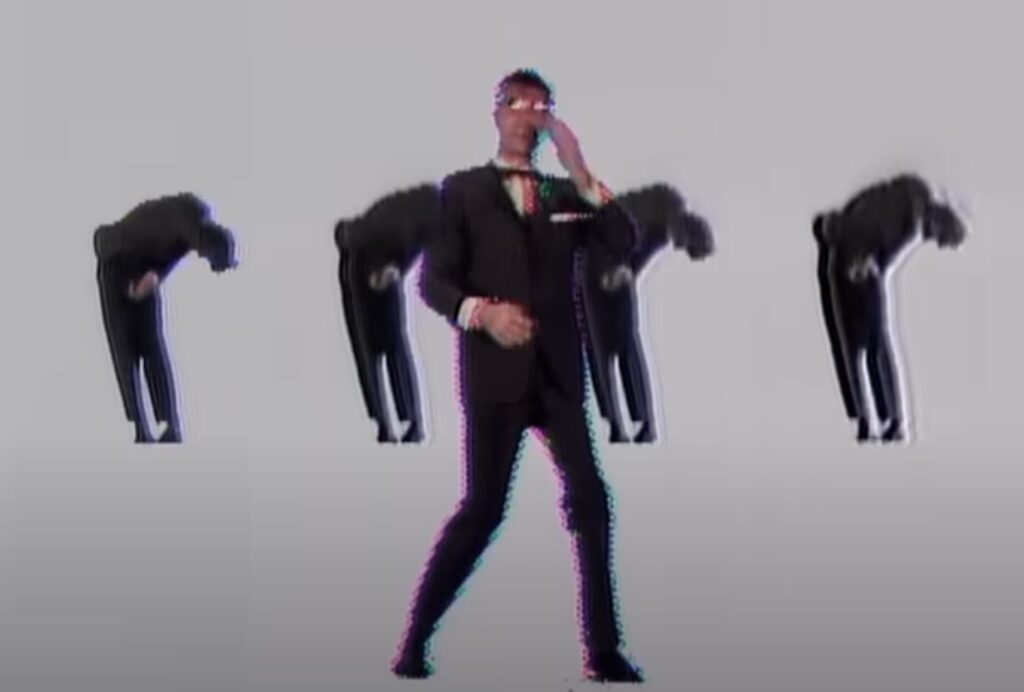
The call and response style, common in revivalist denominations, of the opening further reenforce this perception as well. What does Byrne now preach from this self-created pulpit?
First, he places the listener in the world of the song, ranging from the depravation of the “shotgun shack” to the abundance of the “beautiful house, with a beautiful wife.” The variation between these two places means that, in essence, the entire world falls into his audience, as no matter where you find yourself, you must listen.
Well, one may begin to wonder how all these things come about, a smart question as Byrne does as well when he says, “and you may ask yourself, ‘Well, how did I get here?'” That metaphysical question is a surprisingly complex one in an 80s New Wave song, especially for a front man who described his writing process as “tr[ying] to write about small things. Paper, animals, a house… Love is kind of big.”
“Letting the days go by
Let the water hold me down”
If you have sat through about five minutes of any English course at Jesuit, you are familiar with the archetype of water, that cleansing, restoring force which symbolizes both life and death remains ever present within literature. In Once in a Lifetime, it is no different, with the aging of letting the days go by. Flowing water representing progression, juxtaposed to the shouted “same as it ever was.”
Now all this talk about life and death and flowing and aging but unchanging may seem to be a rather depressing fate, and really nothing to do with God; certainly people have interpreted the song that way. The most common read of the song says it criticizes the materialistic yuppie movement of the 80s, but it is a conclusion I, and the two writers of the lyrics, disagree with.

Byrne’s takeaway from his own lyrics was revealed in a 2000 interview with NPR’s All Things Considered: https://www.npr.org/2000/03/27/1072131/once-in-a-lifetime
“You know, we operate half-awake or on autopilot and end up, whatever, with a house and family and job and everything else, and we haven’t really stopped to ask ourselves, ‘How did I get here?'”
Producer Brian Eno had an even more enthusiastic take on the song- “It’s very up and, like, looking out to the world and saying, ‘What a fantastic place we live in. Let’s celebrate it.'”
Neither of those sound like the pessimistic criticism of crass consumer culture. Instead, it’s a small celebration of the small moments of life, that brings us towards understanding our role in the cosmos.
Does this mean anything?
I promised at the start of this article this would loop back towards God, and here we are making the great curve. Once in a Lifetime never definitively answers how did we get here, but in the closing lines of the song, a small lyric breaks the rhymical repetition of “same as it ever was.”
“And here, a twister comes, here comes the twister”
Well, what is most likely the ‘twister’ or whirlwind in this deeply spiritual song? In the Book of Job, God tests his faithful servant, Job. Job possesses, in fact, a beautiful house, and the ancient equivalent of a large automobile, the giant flocks of sheep and heads of cattle. It obviously is not a perfect one to one comparison, but the allusion is clearly there.
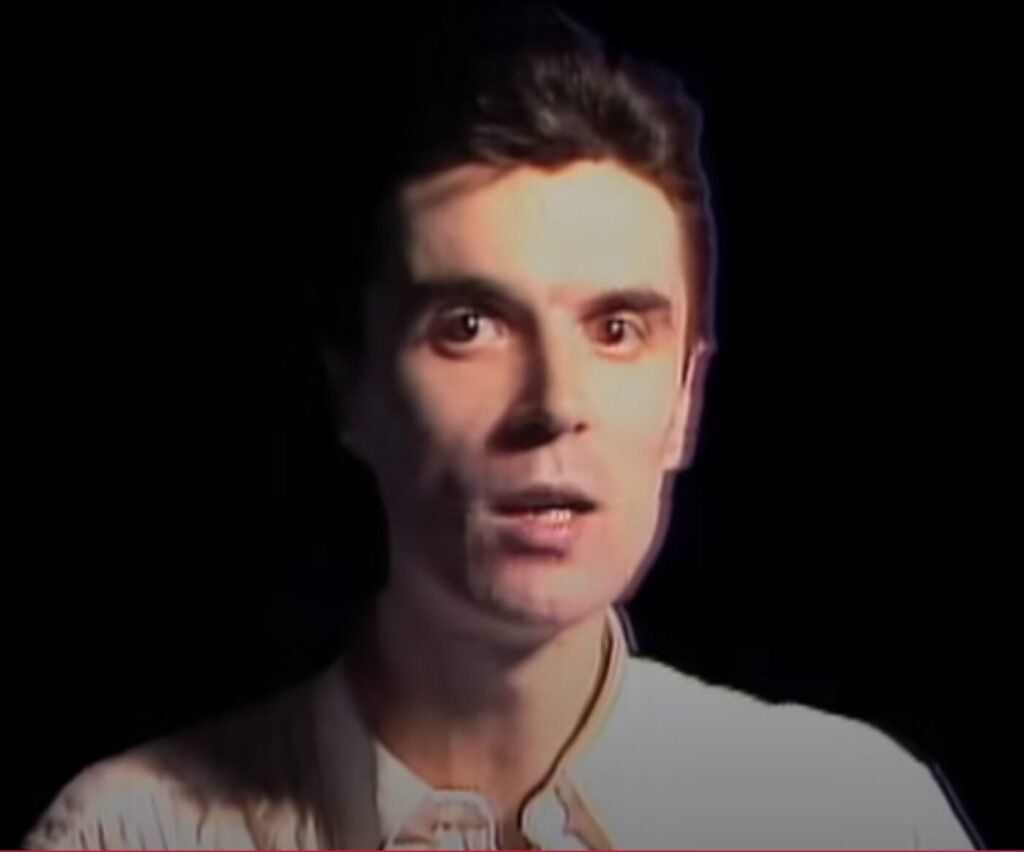
To return to the music video, at the very end, one can see Byrne, no longer spastically moving, no longer in his strange and sweat-soaked attire, calmly singing. Despite things being “the same as it ever was,” the questions he has asked throughout the whole song have seemingly been answered.
Looking Beyond the Song
We consciously comprehend how we rest upon the shoulders of giants in art, those of the great Biblical stories and classical works which gave us our meaning, but it becomes hard to incorporate this into the way we think of contemporary works; For the aspiring artists, whether that be music, film, authors, painters, you have it, it becomes doubly difficult to incorporate it into your work. However, carefully watching, listening, and reading, you can see the shining light of this Biblical base peering through the clouds of the rest of modern art.
In perhaps the most obvious example of Biblically inspired storytelling, Keanu Reeves’ Neo serves as perhaps the clearest Christ allegory in modern media. His prophesied abilities lead him to redeem and save the world, even descending into the center of the earth and “dying” in a sense to achieve this.
Dune plays with Christian images as well, oftentimes subverting them, but to understand the subversion one must first understand the source being subverted. Indeed, Paul, already a long-prophesied messiah, wanders the desert for spiritual enlightenment. He however embraces the path which Christ did not, violently fighting to overthrow the empire into which he was born.
Ultimately, because the Bible is the primary source of truth, goodness, beauty, and all of the other adjectives we tend to wish to reflect in art, it becomes impossible to not engage with it on a serious level if one is striving to make great art. David Byrne and the rest of the Talking Heads just happened to do it in one of the greatest songs of all time.