

Background
Before I continue, this article does contain major spoilers for Project Hail Mary.
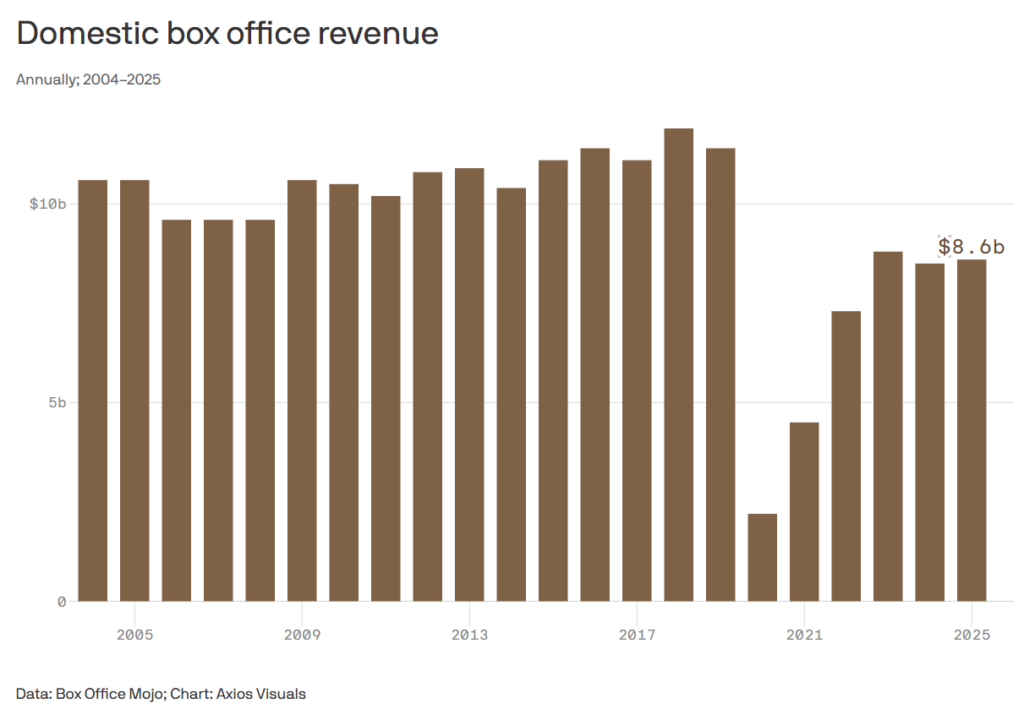
Over the past 6 years, the US Film Box Office has fallen off of a cliff. In 2025, the domestic box office fell short of analyst predictions yet again, coming in at 400 million dollars short of predictions and landing at 8.6 billion dollars in net sales. This number falls 27% short of 2019 pre-Covid highs of 11.4 billion dollars. While this number has significantly recovered from Covid lows, it still marks a concerning trend for the movie industry. While other entertainment businesses like amusement parks and concerts have easily returned and exceeded pre-Covid highs, theatrical releases continue to flounder and grow in obscurity in the public eye.
What could explain this trend? Wall Street analysts and people in the “know” continually point to social media apps as the reason for their failures. Critics claim that social media has destroyed the audience’s attention span, that Americans are not sophisticated enough to understand Hollywood’s artistry anymore, that modern viewers just don’t want to sit down for an hour and a half long movie. Industry insiders say that theatrical releases fail because people want shorter, simpler films. They don’t want to sit down and watch 3-hour marathons in theaters because no one’s going to stay focused for that long. Matt Damon recently revealed on the Joe Rogan Podcast that now Netflix instructs film makers to repeat key plot points 3-4 times in their movies, so that people scrolling on their phones can still understand the plot line. In short, we’ve been told that the failure of the box office is not Hollywood’s fault, but rather the dumbing down of the American public. However, that’s a lie. And the recent release of Project Hail Mary just proved everyone, all the “industry experts,” wrong.
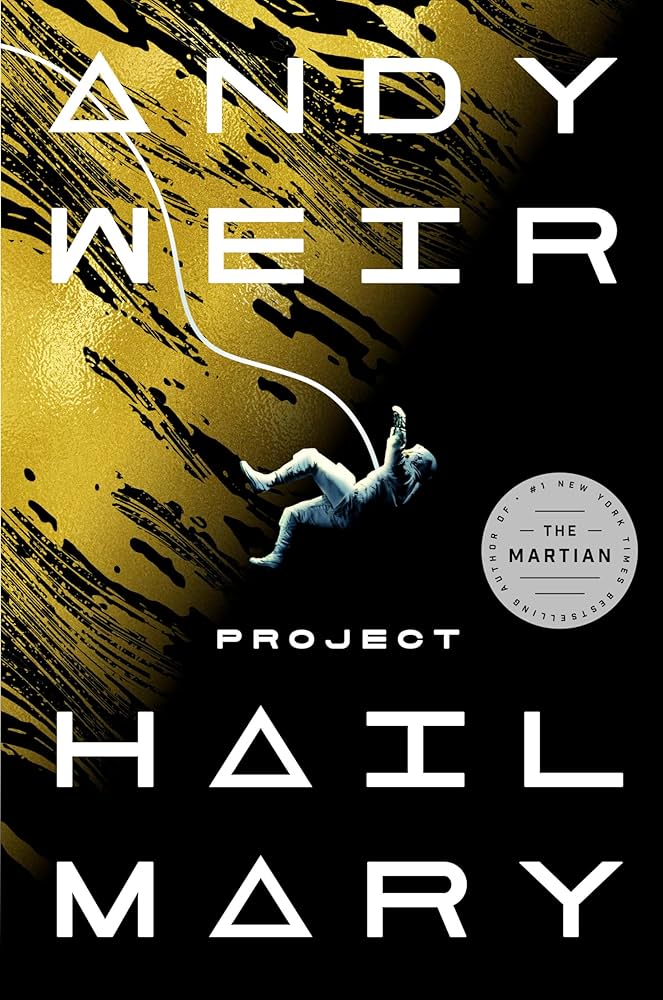
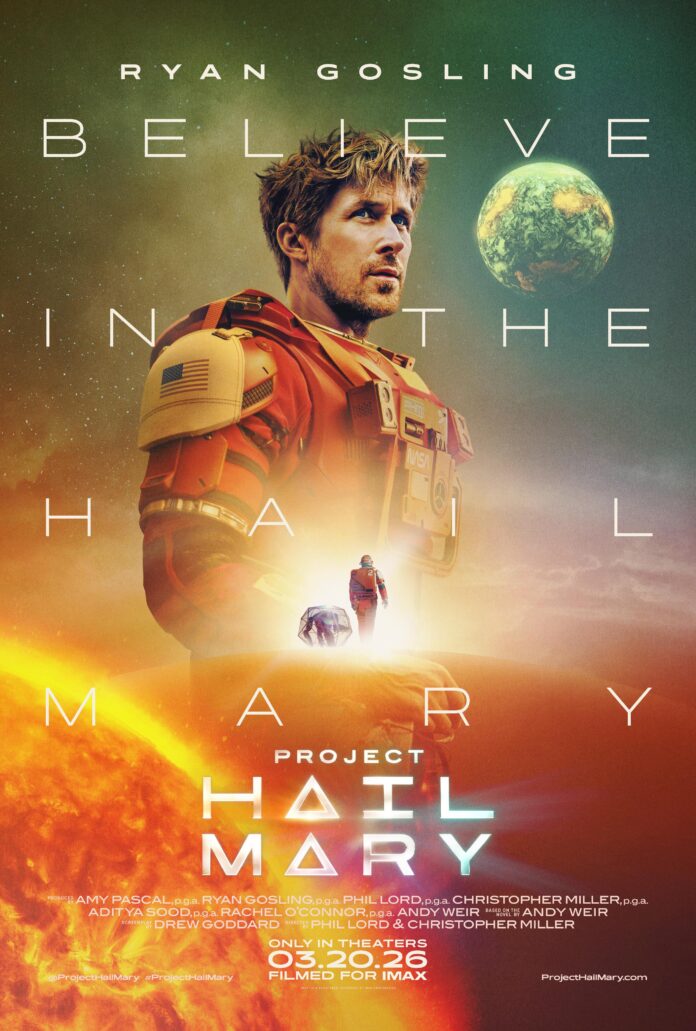
When MGM Studios announced they were creating a movie adaption of the popular sci-fi novel Project Hail Mary by Andy Weir, many people looked down upon the project skeptically. First of all, the film’s total run time sits at 2 hours and 37 minutes. Who’s going to have the attention span to sit down for that long to watch it? Also, it’s a stand-alone film, with no past IP to support the project. How can a movie succeed if it doesn’t have other draws like Han Solo cameos or Spiderman references to draw in crowds? Additionally, the directors for the project, Phil Lord and Christopher Miller, seemed inexperienced for the project. While they have directed past successes like Spiderman: Into the Spiderverse and 21 Jump Street, they had never tackled a sci-fi project before.
For all of these reasons, many remained skeptical of the project. That was, until they saw the film. Over spring break weekend, Project Hail Mary destroyed all expectations, receiving a 95% rotten tomatoes score, and grossing over 80.4 million dollars in gross domestic revenue and 140 million dollars worldwide over the first weekend alone. With the film receiving so much praise, some even calling it the best science fiction film of the decade, I had to see it with my friends. And, after watching the film and reflecting upon it for a while, I’m pleased to say that Project Hail Mary lived up to all the hype and more.
Review
Plot Synopsis

Project Hail Mary is centered around the story of a man, Dr. Ryland Grace (played by Ryan Gosling), who wakes up from a coma to find himself on a starship, millions of miles away from earth. He has no memory of who he is, how he got there, or what he is supposed to do in the first place. As he explores the starship he finds the bodies of the other two travelers, dead from the coma. All alone, he searches for answers. While exploring the ship, Dr. Ryland Grace periodically has flashbacks to his life back on earth before the coma.
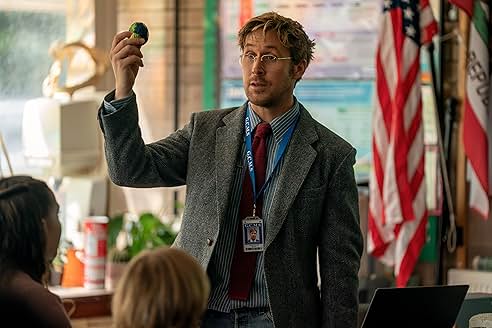
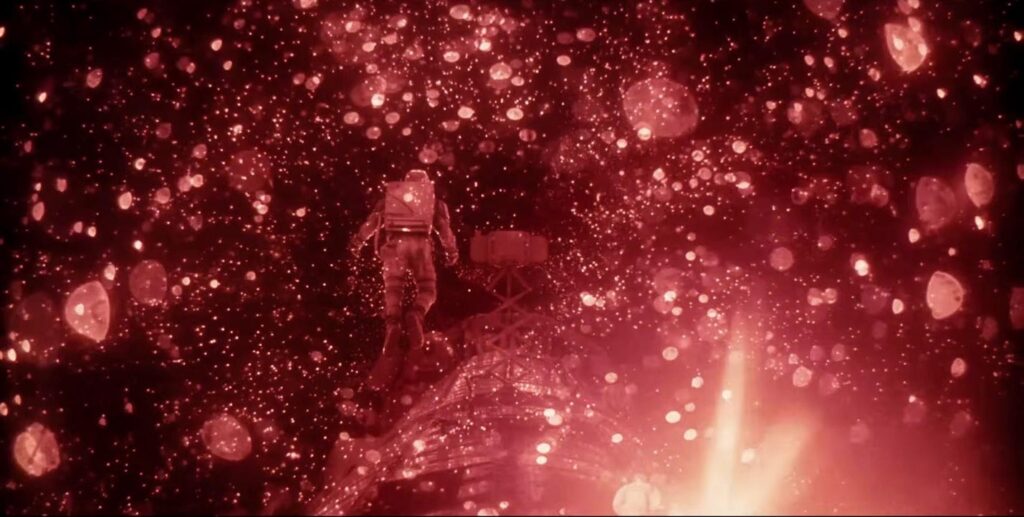
In the flashbacks, we observe Dr. Grace as he teaches astronomy to a class of junior high students. During the class, we learn that a line of red dust, called astrophage, has attached itself to the sun, gnawing away at the surface. The astrophage slowly diminishes the brightness and strength of the sun, a worrying trend that will cause the temperature of the earth to drop by double digits in the next 30 years and causing at least a quarter of the population to die of starvation as crops fail. Right after class, a mysterious lady demands Dr. Grace to come with her to study a sample of this mysterious substance (astrophage). We learn that the lady is Eva Stratt (played by Sandra Hueller), the director of the world’s task force dedicated to preventing the death of the sun. As Dr. Grace studies the astrophage, he realizes that it is a unicellular organism that absorbs the energy of the sun and then emits it, essentially “eating” the sun.
Astrophage has infected and dimmed every nearby star. However, one star, Tau Ceti, has resisted the infection. By designing a spaceship that utilizes the energy-dense astrophage as fuel, astronauts can discover what prevents the astrophage from eating the star and use that knowledge to save earth’s sun and the planet from societal collapse. The only problem? Eva Stratt’s committee only has enough astrophage to get the ship to Tau Ceti and send a probe with the astronauts’ messages back, leaving the astronauts stranded to die in the eternal abyss of space.
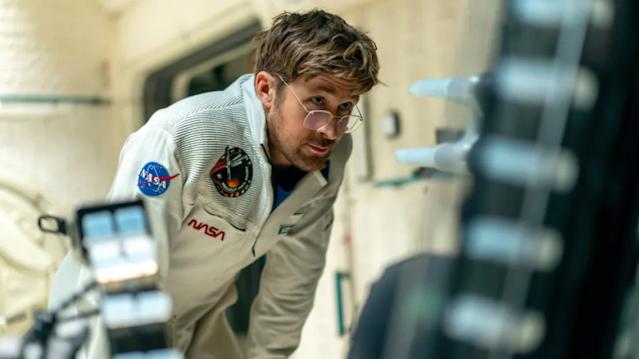
Through more flashbacks, we see Dr. Grace as he trains the 3 astronauts for their mission over the next few months. However, only days before launch, an accident leaves both the science officer for the mission and their backup dead. With no one to replace the astronauts before liftoff, Eva Stratt asks Dr. Grace to join the mission. Knowing it to be suicide, he refuses, but Stratt forces him to anyways through inducing his coma early, as he is the only scientist still alive with enough knowledge to understand what about Tau Ceti prevents the astrophage from attacking it.
Thirteen years later, Dr. Grace emerges from his coma en route to Tau Ceti. However, an alien structure quickly approaches his ship, one of orders of magnitudes larger than Grace’s. Surprised and fearful, Grace performs several evasive measures, but the alien spaceship keeps following his starship before he resigns to his fate. However, rather than attacking his ship, the foreign ship sends messages in the form of sculptures before creating a bridge between the two ships. As Grace crosses, he has his first encounter with the alien creature he comes to call Rocky. With no mouth, nose or eyes, and a voice that sounds like the shriek of a bat, Dr. Grace hides from the purview of the monster at first. However, he eventually attempts to communicate with Rocky using a computer to create a translator between the two.
Dr. Grace comes to find out that radiation has killed all of Rocky’s crew, leaving Rocky as the last remaining being on his ship. In Rocky’s home world, astrophage has infected their sun too, and his people also sent him to investigate a cure for the astrophage. Together, Dr. Grace and Rocky decide to work together to find out the cure for the astrophage to save their home worlds.
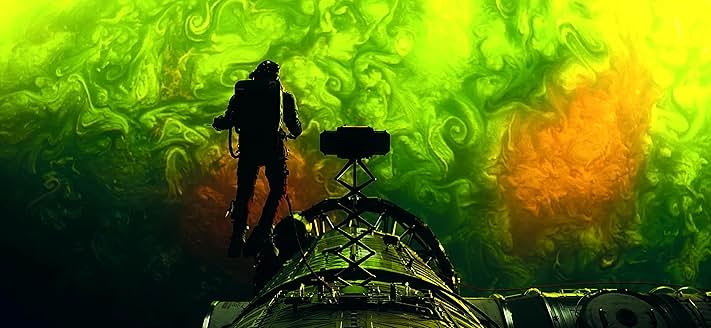
Through collecting samples of the atmospheres of nearby planets and other escapades, Rocky and Dr. Grace discover that the cure to the astrophage is a microbe called “Taumoeba” that acts as an apex predator to the astrophage and eats it. Despite multiple trials and tribulations, including the two of them almost dying after a near collision with a planet, Rocky and Dr. Grace prepare to make their goodbyes. Rocky, upon hearing that Dr. Grace would die in space, gives Grace the fuel to return to earth so they can both return back triumphantly.
However, while Dr. Grace journeys back, he realizes a fatal flaw in how they stored the Taumoeba: it can escape the container they built for it. While Dr. Grace is able to stop the Taumoeba in his own ship from escaping and devouring the astrophage he is using as fuel, he knows Rocky does not possess the technical knowhow to stop the Taumoeba’s escape. Dr. Grace is faced with a dilemma as he does not have enough fuel to go back to earth and fly to Rocky to warn him; he must choose one or the other. Does he save his own life and go back to earth while letting Rocky and his people die, or does he sacrifice his life on earth to save his new friend?
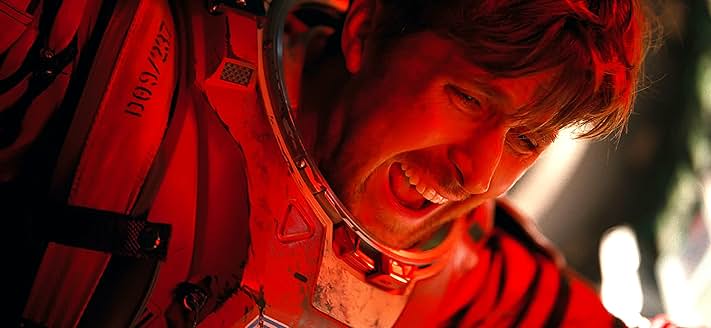
Dr. Grace chooses the latter and sends multiple probes to earth with the taumoeba which are recovered on earth by Eva Stratt. The ending cuts to Dr. Grace talking with Rocky on his home planet. He has sacrificed his life on earth to save his friend, the ultimate act of selflessness. Yet, his new life on Erid, Rocky’s home, is far from desolate. The final scene cuts to Dr. Grace talking with Rocky, before he turns to a classroom of young Eridian children who he teaches science to, fulfilling his life’s purpose as an educator while also saving everyone he loves through his selfless action, a beautiful ending to a well-made film.
Cinematography

This movie delights in everything, but especially the cinematography. The movie is just so visually stunning in every single scene. The cinematographer, Greig Fraser, hits with yet another banger. He beautifully elevates the contrast between the comfort and warmth of earth and the vastness of space through his usage of IMAX filming. Normal film cameras shoot in an aspect of 2.39:1. Fraser uses this for all earth scenes. However, he uses a special IMAX camera for all space scenes that films at the much wider aspect ratio of 1.43:1. This contrast in width immerses the audience in the realization of the emptiness of space, magnifying the stakes of the mission. This contrast was particularly visible in IMAX movie theaters like the one that I watched the film in, where the film literally grew even wider during space scenes.
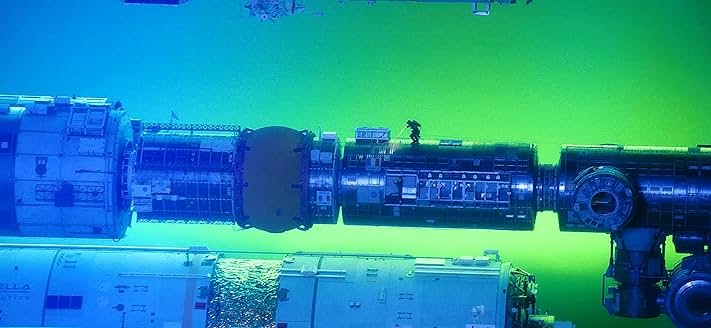
Additionally, Greig Fraser refused to use a single green screen shot in the entirety of the film. Not using a green screen is incredibly rare in modern films. However, not using green screens in a high-tech sci-fi movie? Unheard of. How did they do this? Through sheer grit along with a little movie magic. Every single scene inside of the spaceship? Entirely real. The set team created the entire interior of the Hail Mary ship as a real set. This meant that instead of Ryan Gosling having to pretend to walk around the ship, he could actually see it and move around the set, allowing him to truly immerse himself and by extension the viewer in the scene. Now, for the true space scenes, there’s no way to walk around using VFX. But even for those scenes, rather than using a green screen, they used a black screen that mirrored the vastness of space, combined with lighting that reflected the lights of space onto Ryan Gosling’s face. This meant that the producers only had to use VFX to generate the stars and planets in the background, foregoing the need to use CGI to generate shadows on Ryan’s face and overall making the film more realistic.
Also, in what seems like a nod to the science fiction movies of old, rather than use CGI to generate Rocky, Fraser took a feather out of George Lucas’ cap: using puppets. In the original Star Wars Trilogy, CGI quite literally wasn’t invented yet. So how did Lucas create characters like Yoda? He hired the famous puppeteer Frank Oz to design and control a Yoda puppet. Whenever Yoda needed to talk, he would reach through the set floor and control his eyes, mouth, and head movement through rods under the floorboards.

In Project Hail Mary, the producers did the same thing. They hired the puppeteer James Ortiz to physically operate and voice a high-tech animatronic Rocky puppet. This added extra realism to the scene and helped Ryan Gosling in his performance abilities by giving him something to talk to rather than just an imaginary CGI being. That being said, the cinematographers did use a touch of CGI on top of the puppet to better illustrate the subtleties of Rocky’s emotions, but this minimal usage of CGI just enhances what is already there instead of acting as a substitute for real work.
Acting
The real beauty in the film stems from the unique bond between Dr. Grace and Rocky. While at first they are both skeptical of each other, they soon form a close-knit bond. They have many differences: the two speak different languages, they’re from two separate worlds and they have different backgrounds. Rocky doesn’t even have a head. However, by the middle of the film, the audience already feels a deep connection with him, thanks to the beautiful writing of Weir and the directors along with the superb acting of Gosling.
Gosling embodies the role of Dr. Grace perfectly. In the film’s beginning, he comes across as an incredibly intelligent but depressed man, resigned to his fate of death among the eternal stars. However, through his conversations with Rocky about the joys of earth and his flashbacks to his past, he slowly regains the fire in his eyes. Additionally, his chemistry with Rocky is incredible. Through simple conversations with Rocky, he realizes all the similarities between them. In simple talks about their home worlds, friends and personal interests, the audience begins to see the two not as two different creatures but as friends.

Conclusion
Overall, Project Hail Mary lived up to all the hype and more. Between the brilliant set design, the relatable characters, the fascinating premise and the on-point acting, this movie was definitely one of the best I have seen in-theaters for quite a while. In a world where industry insiders are pushing filmmakers to shorten and dumb down their films for modern audiences, Project Hail Mary acts as a beacon of hope for the darkness of the film industry. We don’t need endless spinoffs and rereleases of classic IPs to come back to the cinemas. We need smart, witty and beautifully produced films like Project Hail Mary.
Overall Review:
10/10
Stay tuned into The Roundup for more movie reviews!