


Scriptwriting is an art built on the foundations of storytelling. I like to think of it as the carefully constructed blueprint, rather than a finished building. When I originally started writing I had dreams of becoming a world renowned author, but then I realized that filling ever inch of a page required a patience and endurance I haven’t mastered. Scriptwriting, in contrast, strips away the excess fluff of a story, and focuses on structure, dialogue and motion.
I have the utmost respect for authors, and novelists, because they must create entire worlds using nothing but language. Scriptwriting, fortunately, shares that responsibility with actors, directors, and designers. In this two-part-series, I hope to break down the fundamentals of scriptwriting, and help you grasp a better understanding of the art form through my own personal experiences.
The ACTION-IDEA.
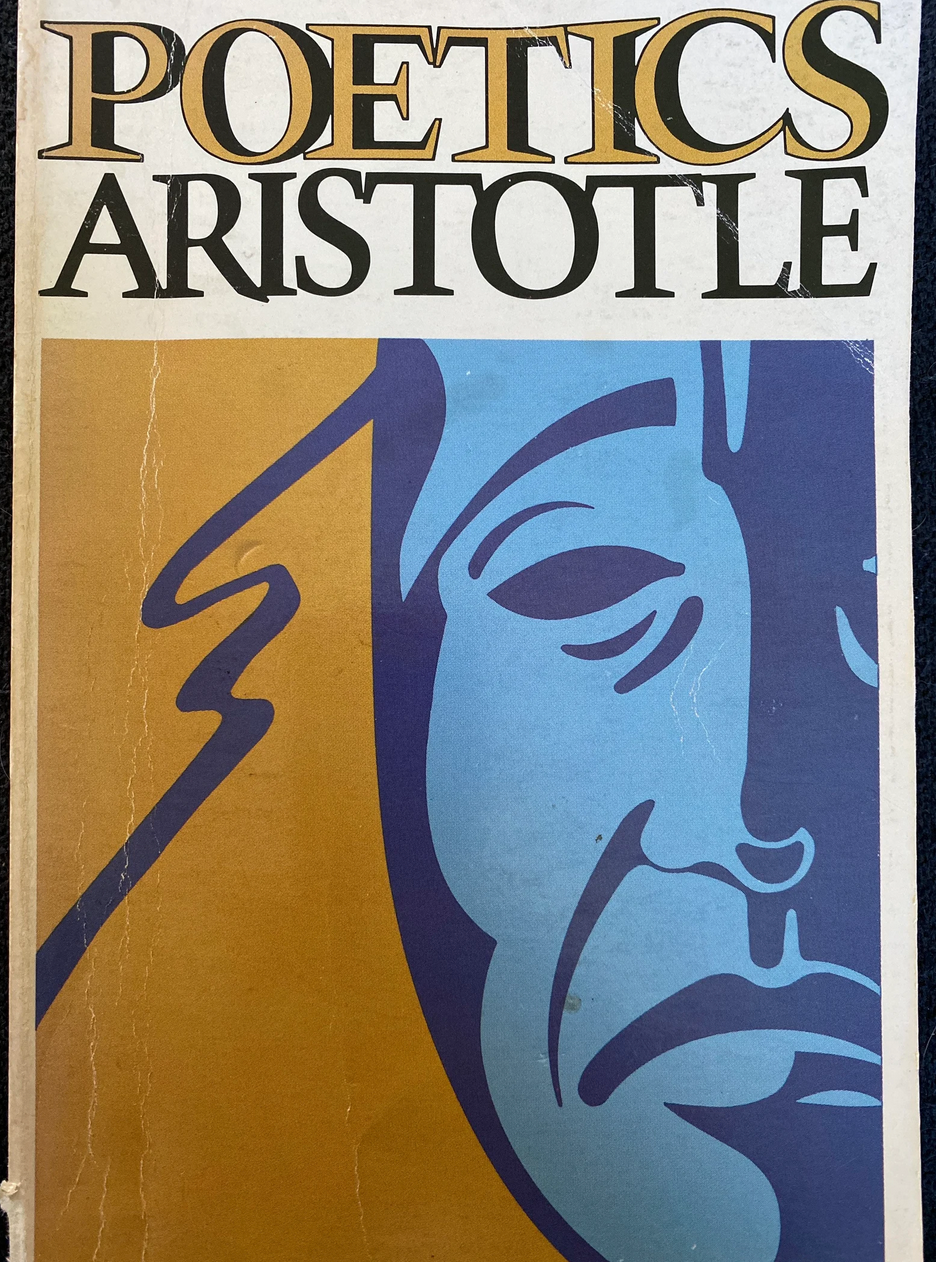
One book that I’ve read, cover to cover, multiple times (and at this point is too annotation ridden to even read) is “Aristotle’s Poetics for Screenwriters,” by Michael Tierno. In this exploration, Michael Tierno talks about how one of the “Fathers of Western Philosophy’s” tips and structure behind story building still stands to this day.
The main idea, pressed into the minds of the reader from the introduction, is the ACTION-IDEA. The ACTION-IDEA is a story’s core action. In Jaws, for example, the ACTION-IDEA is “a man trying to stop a killer shark.” Without the ACTION-IDEA, there is no story. For a further break down of this idea, I’ll use my most recent play, “Charrington’s Hall.”
In “Charrington’s Hall,” every single character has their own ACTION-IDEA, which is encompassed within the main ACTION-IDEA of “as live theatre dies in the face of modernity, a group of artists must decide whether to evolve, escape, or be destroyed by the very dreams that once gave them purpose.” The ACTION-IDEA fundamentally is the catalyst that creates every single character ark. Edward Charrington’s ACTION-IDEA is to “sacrifice himself so his dream can evolve.” Matthew’s, our main protagonist, is to “leave his dream behind.” Richard’s, our main antagonist, is to “bring everyone down with him.” Without an ACTION-IDEA, the story cannot progress and without character ACTION-IDEA’s that contrast you cannot have “tragedy,” in Aristotle’s words.
The IDEA itself.

Now, you may be screaming at your screen right now, “How do I make an ACTION-IDEA if I cannot even get an Idea?!” Whoa, whoa, stop screaming at your screen. For starters, if you want to get better at writing– or need help coming up with an idea in general, try writing a treatment for an already popularized TV Show, or Film. When I hit a large writer’s block, I tend to always go back to the same show, “King of Queens.”
“King of Queens,” follows a delivery driver named Doug Heffernan (played by Kevin James), his wife Carrie (played by Leah Remini), and his father-in-law, Arthur Spooner (played by Jerry Stiller), who all live together. Some examples of versions I’ve written is Doug accidentally getting sent to a fat camp, becoming a ripped body builder. Carrie becoming obsessed with him, and at the end of the episode, well let’s just go straight to it:
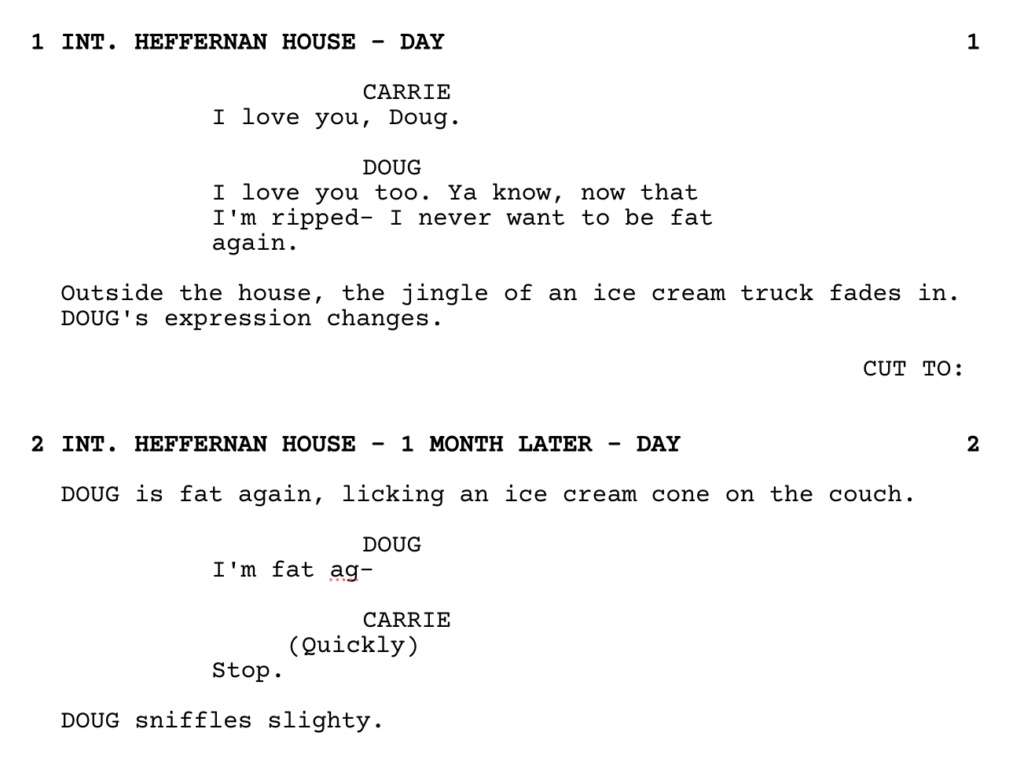
Practicing writing such as this, allows you to build off of an idea, while also inserting your own voice as a writer. If you want to professionally write for T.V., this is an incredible way to practice and gain audience-capturing ideas.
Another way to always keep the cogs turning, is by taking personal experience and writing it as a script. When I first wanted to start writing, my parents got me a mug that said “I’m a writer. Anything you say will probably be featured in my book,” or something along those lines, and as cringey as it is, it’s completely true. Because of this, I highly recommend carrying around a notebook, or having a notes page on your phone solely for script ideas. You don’t even have to complete a single sentence, as long as you have the fundamentals, you can turn it into an idea.
For example, one day, my dad told me to take the garbage out. It was night, very dark, and as I walked towards the alleyway, I got scared, so I wrote it down. Then, I started developing a horror script about kids who take out the trash and go missing. The big finale was a kid running from the fence gate, as a monster emerges and pulls him into the darkness. I’ll be the first to admit, that scripted SUCKED. I mean it was pretty horrendous, but I never deleted it. Later, when I was trying to figure out the ending to my gangster short film “Walkin’ the Bridge,” I realized I needed this character assassinated, and it had to be scary. I wanted to give the audience a nice false hope, and then BANG, its over. So, I pulled the alleyway idea. The main character’s wife tells him to take out the trash, he grabs it, walks into the alleyway, where he is met by hitmen, who gun him down. It was the perfect ending, and the reason you should never throw out an idea.
You never know when ideas will come to you, and no matter what, you should always write it down, because the next time you hit a writer’s block, looking through that notebook, or notes folder, could be the thing that sets you ahead.
The DIALOGUE.
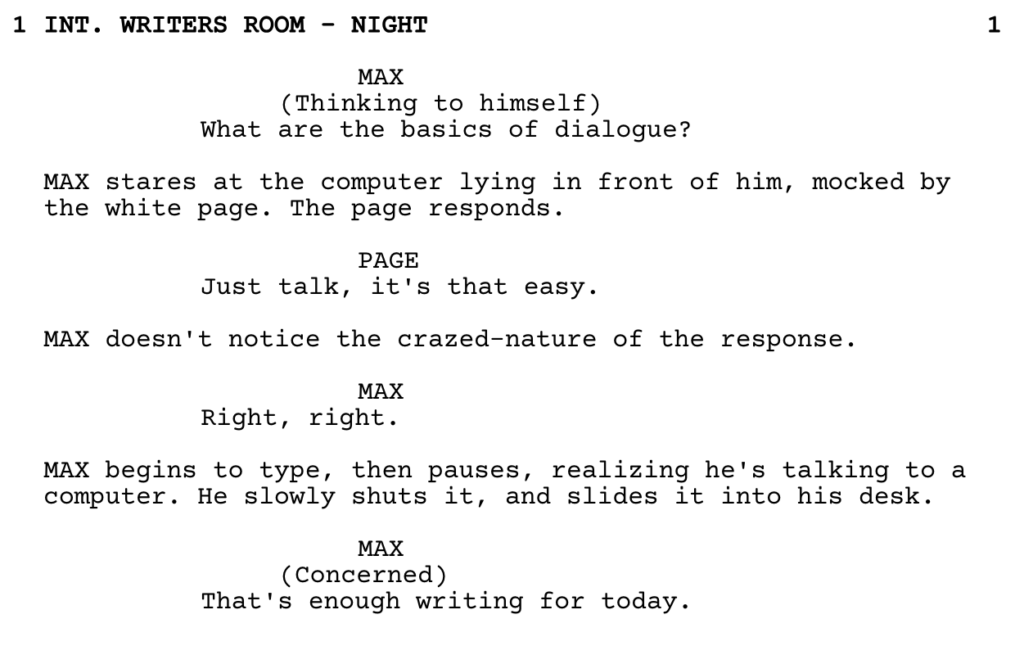
Dialogue, Dialogue, Dialogue. Dialogue is the difference between a silent film and a “talkie.” Well, duh, but you get the point. This is the rhythm of the script, but it is also the killer of audience attention. On one spectrum, interesting dialogue, like in scripts such as “12 Angry Men,” can be the soul of the show, and the main thing praised by critics. On the other end, too much dialogue that feels like “fluff,” especially in playwriting, becomes the moment where the audience notices how uncomfortable their chair is and when the most bathroom trips are prompted.
One of the biggest issues amateur scriptwriters confront is bland dialogue. Too often, characters speak not as people with distinct desires and histories, but as a mouthpiece for the writer’s ideas. Not every single word that comes out of a character’s mouth has to be poetic. In fact, it rarely should. No human talks in verses, and many don’t with the correct grammar. Most of the time, the writer puts too much of their own agenda into the character’s dialogue, when in fact it should be the area that separates itself the most from the author. If every single character speaks like the writer, then they all become coerced in a mush of bland uniformity and collectivism.
A big problem I find now, in this day and age, is how social media zooms in too much on films. Every reel you see about a film shows the character talking very philosophically or with profound thought, but the matter of the fact is that in whatever particular film it is, that very likely is the climax. The moment where the character should have these profound thoughts, but it shrinks the script so far down that every new writer thinks they need all their characters to talk like that.
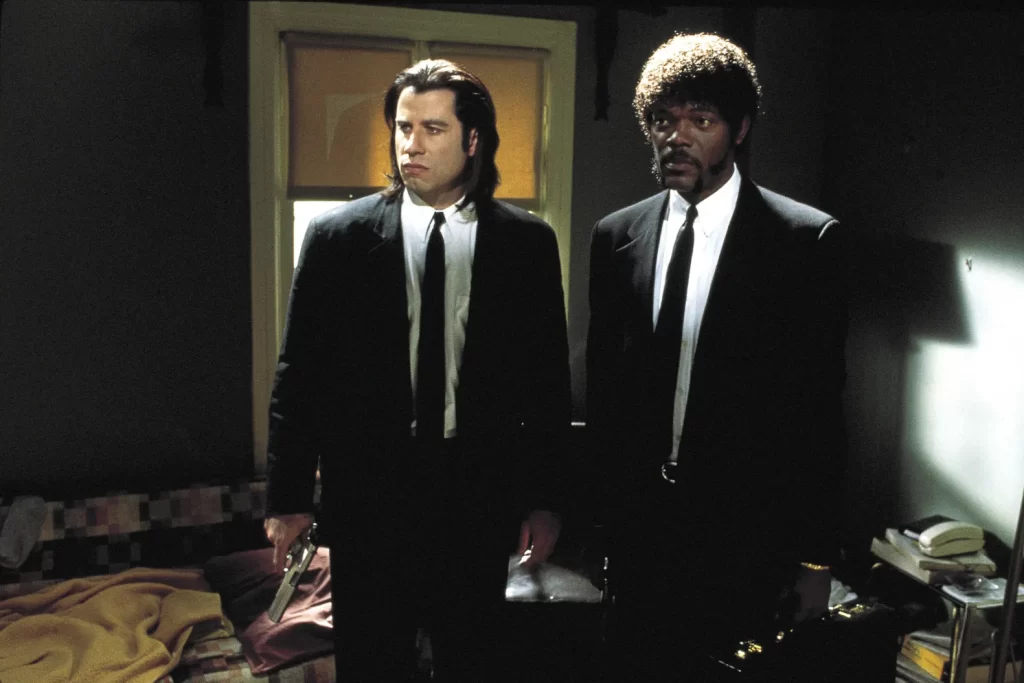
For example, in Pulp Fiction, you have a moment where Jules is in his big monologue, where he says “The truth is you’re the weak. And I’m the tyranny of evil men.” BOOM, profound, thought-out, powerful, but if you look earlier in the film he says things such as “You know what they call a Quarter Pounder with cheese in Paris? […] A royale with cheese.” This is the best showing of how not every piece of dialogue has to be for the purpose of the conflict. I’m not saying it doesn’t have to have a purpose, I’m saying this reveals the character. This reveals the connection every character has to the audience, that they’re human. It reveals something other than the conflict.
Final Thoughts
At the end of the day, the audience comes to the theatre to be entertained, and you cannot laugh with a character, or cry with them, if you don’t feel the humanity with them. The moments where you feel the most, are when you can point to a character and say, “I’ve said stuff like that,” or “I’ve been there,” and all of that is found in the basis of the dialogue.
