


As I and other studious Juniors study the complex topic of ethics in our Sacraments Morality and Justice course (thank you Mr. Ellis), we inevitably have run into the unique philosophical viewpoint of Utilitarianism. In short, the idea that argues for the “greatest amount of good for the greatest number of people.” While I myself am not a Utilitarian, I believe that I understand the concept well enough to give a well-thought-out Utilitarian perspective on the idea of NBA Teams tanking (again, thank you Mr. Ellis).
Utilitarianism Definition
According to Google, Utilitarianism can be defined as a consequentialist ethical theory that defines the right action as the one that maximizes overall happiness, well-being, or pleasure, while minimizing pain or suffering for the greatest number of people. In simpler words, whichever produces less pain and suffering and brings about more pleasure is the right decision no matter what. This belief is passed on by fellow Utilitarians and is so prominent an ethical philosophy that it is discussed as its own unit in Junior Catholic theology. While I’ll say there are certainly a few large holes in the outcome-based philosophy itself, I must admit that it has a strong argument when it comes to NBA teams tanking.
The NBA Problem

Nowadays tanking has become too obvious and too expected in the NBA. Teams like the Washington Wizards and the New Orleans Pelicans have been stuck at the bottom, tanking away their entire season for the chance to return to contention within the next few years. While the league is against it, as it hurts TV ratings, regular season competitiveness, and boosts predictability, many teams are fine with it, even encouraging it in some cases. There are two very clear effects of the decision to tank. Number one, the team sucks. Fans are disappointed, they make less money, the players are unhappy with losing, etc. On the other hand, there is the potential for the team to become good in the future and potentially win a championship. We saw this with the Oklahoma City Thunder. After multiple losing seasons, they built their way back up to the top of the league after the Westbrook era ended. So, what would a Utilitarian argue?
Would they view it as immoral as it causes pain and suffering for the fans and lessens profits made off the team short term? Would the Utilitarian oppose losing on purpose, as it doesn’t maximize utility? Or would they support it on the possibility of a potential good outcome, in which the team succeeds and wins a lot, and the fans are happy, and the team makes more money? Another question emerges: Can the Utilitarian justify lowering utility in the short term simply on the basis of potential for maximized utility later on? A true Utilitarian’s opinion is needed to solidify this claim, but I will take a guess at it: A true Utilitarian would argue that tanking is morally justified only if the long-term happiness created by future success outweighs the short-term suffering it causes for fans, players, and the league as a whole. That is, if a team loses consistently for 5 years and is repaid with a few playoff berths in a row, that would not be morally justified.
The Concern for Tanking

There is one aspect that I have yet to reveal. The sad, harsh reality is that the majority of NBA tank’s fail. More specifically, they fail to bring the team a championship as a direct result of a tank. For example, the Cleveland Cavaliers in the early 2010s. They tanked heavily and even received multiple number one overall picks in the process. And, to top it all off, they won a championship, completing the rebuild. Only problem is that wasn’t the case. Their championship success in 2016 was not because of the rebuild. It was because LeBron returned, on his own accord, to finish what he started. If Cleveland had not tanked and won more games, maybe they wouldn’t have drafted Kyrie Irving, but it’s hard to argue that Anthony Bennett had a huge impact on the Cavaliers in 2016. Even more, “The Process” rebuild never led to a championship, even though it resulted in players like Joel Embiid.
So, with the overwhelming statistic of tanking not resulting in a direct championship afterwards, does that change the Utilitarian verdict, as it is increasingly more likely that the short-term suffering outweighs the potential long-term payout? A Utilitarian would probably argue it does, and that tanking is immoral as it puts to risk a prolonged suffering for the fans of a franchise, the players, and the franchise itself. Also, depriving fans from being able to watch their favorite players (whether the players are good or not) just to lose games provides even less reason for tanking to be supported by Utilitarianism.
Mathematical Estimate

For one final argument, I’m going to do an aggregate estimation, Utilitarian style. Let’s say that every time a team has a losing season (under 25 wins or so), each player, due to their disappointment, loses 100 units of happiness. Each fan loses about 10 units, and the owner not only loses 500 units of happiness from disappointment and shame but also loses 1000 units of happiness due to lack of profits he is making. The NBA itself, aka Commissioner Adam Silver, loses 5000 units of happiness from a lack of viewership. Meanwhile, if and when that same team wins a championship, each player gains 1000 units of happiness, the fans 100, and the owner 2000. Also, profits are up, so the owner gains 5000 units and the NBA gains a small profit of happiness with a cool rebuild story dragging in new viewers (1000 units).
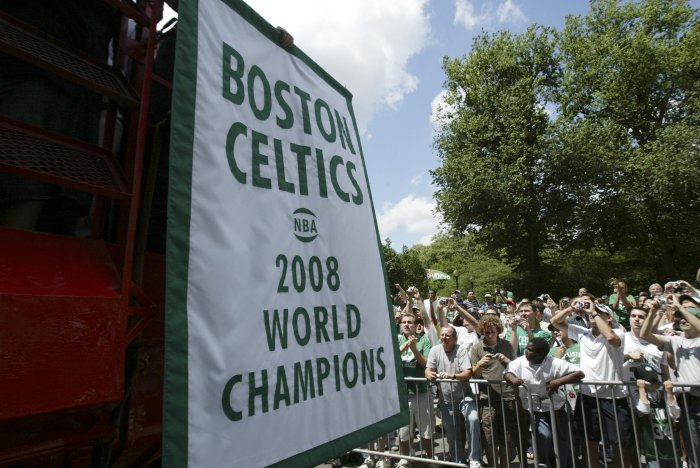
In total, the short-term loss comes out to a loss of 208,000 units of happiness in this estimation. Meanwhile, the long-term potential benefit of a championship comes out to 2,023,000. Now, that means that in order to justify tanking, the team must have at least a 10% chance of winning a championship within the next year, or the potential benefit is outweighed in utility by the short-term suffering. There has been one instance in NBA history that a team that won fewer than 25 games has won the championship the next year, and there is an argument that it had nothing to do with tanking. Instead, the 2007-08 Boston Celtics acquired Kevin Garnett and Ray Allen in free agency, not through the draft. Therefore, tanking has never produced an outcome that fits the criteria to pass under Utilitarianism.
In Conclusion
This thought experiment has inspired me to view more sports concepts under different ethical frameworks taught in the Sacraments Morality and Justice course at Jesuit. That being said, this one ultimately fails. While a Utilitarianism would obviously oppose tanking in the NBA, there is no obligation for us to oblige with the Utilitarian perspective. However, it is certainly something to think about. As the NBA navigates the complex issue of NBA teams tanking, they must consider all perspectives, so why can’t a Utilitarian have one?
Stay tuned into The Roundup for more Student Viewpoints!