

On Saturday, November 8th, the Jesuit Model United Nations team returned to one of the largest and most competitive Model UN conferences in the Dallas/Fort Worth area: DAMUN (Dallas Area Model United Nations). With more than 30 schools and a record breaking six hundred students in attendance, the event brought together delegates eager to debate global issues, negotiate solutions, and collaborate across diverse committees. Jesuit delegates took on a wide mix of countries and committees, each requiring its own background research and strategy. By the end of the competition, the team walked away with an award, marking another strong showing for Jesuit MUN.
Before diving into the results, it helps to look at what went into the day, everything from the committees students were assigned to the work they put in beforehand.

How to Model UN: Committees and Position Papers
DAMUN hosts a huge variety of committees, from classic UN bodies to smaller, specialized groups, and even a few that are, let’s just say, abstract. These Committees include United Nations Security Council (UNSC), the World Health Organization (WHO), Arab League, Economic and Social Council (ECOSOC), Human Rights Council, International Court of Justice, General Assembly, and the How to Train Your Dragon themed Crisis Council (This is real).
DAMUN’s setup gives delegates a chance to jump into completely different styles of debate depending on where they end up. Larger committees like the General Assembly are packed with delegates who all want their voices heard, so speeches feel more like navigating controlled chaos. On the other hand, specialized groups such as the International Court of Justice or the UN Security Council offer a tighter, more intense atmosphere, where every word matters and alliances shift quickly. The Arab League is a unique committee as two members work together to represent one nation, which means delegates have to be perfectly in sync. It’s not just about knowing your country’s policies. it’s about matching your partner’s speaking style, strategy, and energy so you look unified in debate.
On the conference floor, success often comes from knowing when to stand firm on key issues and when to compromise, turning individual positions into resolutions that reflect teamwork and strategy. Even in the fast-paced, sometimes chaotic crisis committees, students learn that diplomacy isn’t just about speaking well, it’s about listening, adapting, and building alliances to solve problems together.
Before actually going on the debate floor, delegates must spend hours researching their assigned countries and draft position papers, which serve as the blueprint for debate and negotiation. These required papers help students organize their arguments, anticipate opposing viewpoints, and propose solutions that can gain support from other delegates.
Jesuit Contestants
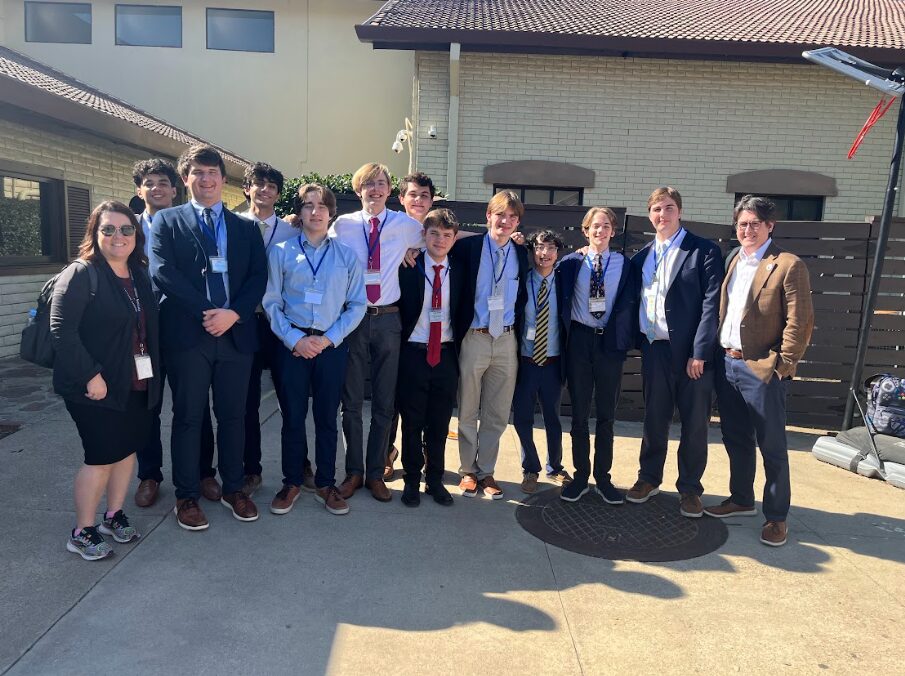
At this year’s conference, Jesuit brought a record-breaking eleven delegates to compete for the title of most distinguished delegate in their committees. Through hours of research, careful preparation, and lively debate, both during and outside of community time, these students navigated the complex world of international politics while representing the interests of their assigned nations.
Adam Peckham ’26 and Wills Blosser ’26 represented Djibouti in the Arab League, while Nicholas Bartel ’27 represented Sudan and Kian Esfahani ’27 represented Kuwait in the General Assembly. Ben Prentice ’28 and Charlie Kubelka ’28 took on Chile and China in the Human Rights Council, Nathan Sliter-Hays ’27 represented Pakistan in the Security Council, Mason Muskovich ’27 represented Poland in the International Court of Justice, and Kobus Brewton Williams ’28 participated in the first Crisis Committee. Everett Bier ’27 represented Lithuania in the World Health Organization and last but not least Gionni Gutierrez ’27 represented Singapore in the World Health Organization as well.

Jesuit’s delegates had the support of faculty moderators Mr. Miller, Mr. Pointer, and Mrs. Hudec, who helped them get ready for every part of the conference. From prepping position papers to planning debate strategies, they made sure the students felt confident and prepared to represent their countries. With their guidance, the delegates were able to navigate the fast-paced world of DAMUN
Club Preparation
Preparation is everything in Model United Nations, and Jesuit’s delegates approached it with full dedication. Long before the conference began, they spent weeks researching, writing, and practicing to make sure they could confidently represent their assigned countries and tackle their committees’ topics.
First, the delegates took part in Model United Nations club meetings during community time, where they learned the ins and outs of MUN procedures. These rules are the backbone of every committee session, shaping how debates unfold, how resolutions are drafted, and how decisions are made. Learning the speaking procedures, motions, draft resolutions, and voting processes is crucial for both newcomers and experienced delegates to participate effectively.
Next, each delegate dove into research on their assigned country, exploring its history, culture, foreign policy, and role in the global community. They also studied the specific topics for their committees, using UN reports, scholarly articles, and news sources to get a clear picture of the issues and their complexities.
Finally, all that research came together in a single position paper. This document lays out the country’s perspective, background information on the issue, and proposed solutions aligned with its policies. A strong position paper combines thorough research with strategic thinking, serving as both a guide for debate and a way to show moderators that the delegate is well-prepared.
Competition Overview with Adam Peckham ’26 and Wills Blosser ’26
Members of the Model United Nations club developed a set of questions to ask Adam Peckham and Wills Blosser, aiming to learn more about their experiences in the Arab League. The questions focused on the challenges they faced, the highlights of their time in committee, and the strategies they used to navigate debates and negotiations.
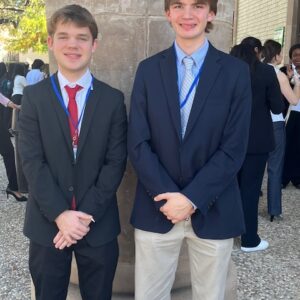
The Interview
Let’s start with how you got ready for the conference. How much time went into your prep, and what were some of the obstacles you ran into along the way?
Wills Blosser:
“Since Adam and I were representing Djibouti in the Arab League, prepping for DAMUN took a good amount of time. The Arab League works differently from most other committees because it has two delegates representing one country, so Adam and I had to make sure we were always on the same page. We split the research, compared notes, and tried to really understand Djibouti’s stance on the issues.
A lot of the info wasn’t super easy to find, so there was definitely some digging involved, but DAMUN gives helpful background on each topic, which made things easier. Once we gathered everything, we worked together on our position paper during community time and sometimes after school.
Honestly, the hardest part was just finding the time to fit everything in with school and other activities. But having Adam there helped a ton, being able to prep as a team made the workload lighter and helped us go into the conference confident about what we were saying.”
How did your day begin? Did you immediately start competing?
Adam Peckham:
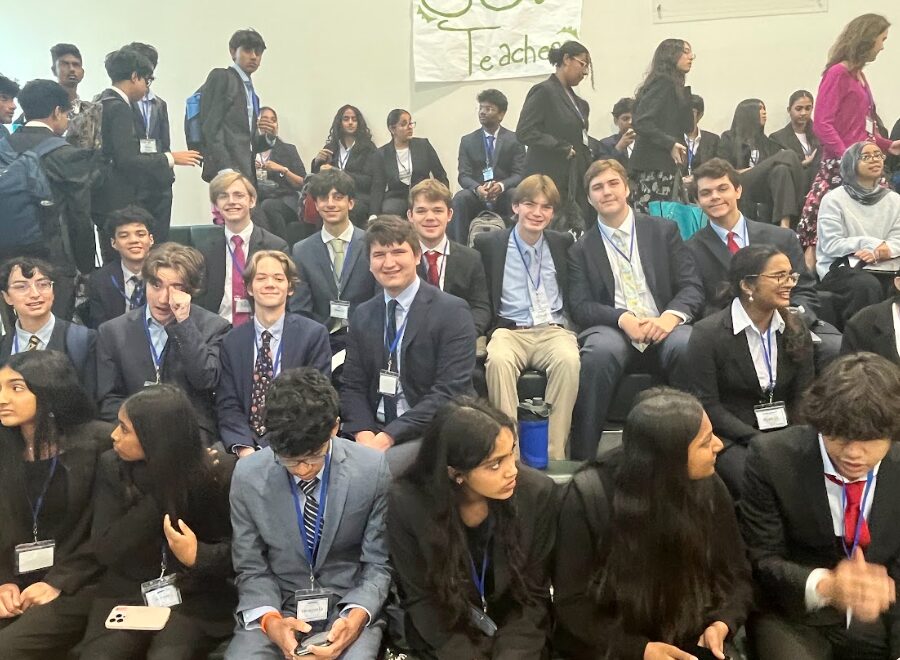
“Our day started pretty early at 8:00 AM on a Saturday. All the Jesuit delegates arrived together, checked in at the front tables, and picked up our lanyards. Once we had everything, we headed into the main assembly room with what felt like hundreds of students from schools all across the area (Which it was). I remember being genuinely surprised at how big this year’s DAMUN was. It definitely felt like the largest one I’ve ever seen.
Before committees began, the conference opened with a few announcements from the DAMUN student leadership, and then we heard from the guest speaker. She worked with the UN on global aid efforts, and her talk really set the tone for the day by showing how the kinds of things we debate in committee actually connect to real-world work. After that, everyone split off to their individual rooms, and that’s when the competition officially began.”
So after the opening ceremony wrapped up, what happened once you got to your committee room? Who were you up against, and what was the size and dynamic of the group you were competing with?
Wills Blosser:
“After the opening ceremony we headed to our room, which ended up being a pretty small classroom. It was actually the smallest committee I’ve ever been in—around thirty people total—but since the Arab League uses pairs to represent each country, the setup felt totally different from anything I’d done before. I was really curious to see how that dynamic would play out once debate started.
I recognized a few delegates from previous years, so it was cool getting to reconnect before things got serious. But once everyone settled in, it was time to focus. We all had to lock in and get ready for whatever the committee was about to throw at us.”
Once everyone settled in, how did the committee actually get started? How did the early procedure unfold?
Adam Peckham:
“After everyone got situated in the room, we moved into opening statements, which really set the tone for the whole day. Our topic was U.S. intervention in the Middle East, which meant every nation had something different—sometimes wildly different—to say about how involved the U.S. should be. Since Wills and I were representing Djibouti, we tried to lighten the mood a bit by opening with a couple of Djibouti puns. It actually got the room laughing, which helped us stand out early and made it easier to speak confidently throughout the session.
But humor aside, we pushed a pretty balanced approach. Djibouti relies heavily on foreign aid and international partnerships, so our argument focused on cooperation, stability, and avoiding extremes. We made sure to frame our stance in a way that showed we understood the topic but were also thinking realistically about our country’s needs.
Once the statements wrapped up, we started to see which countries were going to be the biggest competitors. Some teams came in with really strong research and confident speakers, so Wills and I immediately started taking notes on who seemed aligned with us and who we might be able to work with later. We spent those early minutes figuring out who had similar goals, who had influence in the room, and how we could form a solid voting bloc. That early planning really helped shape how we approached the rest of the committee.”
How did the conference progress? Did you face any challenges?
Wills Blosser:
“The conference progressed in a mix of fast-paced debate and strategic maneuvering. We spent a lot of time in both moderated and unmoderated caucuses, moderated caucuses are when the chair calls on delegates to speak in turn about a specific topic, while unmoderated caucuses let delegates move around the room freely to negotiate and form alliances. At first, it was a little intimidating, but Adam and I quickly decided to be bold. We went against Saudi Arabia, who was trying to form a coalition with the a large group of delegates, and started pushing our own ideas.
Step by step, we expanded our influence, reaching out to Kuwait and other nations to gain leverage. It wasn’t always smooth, we even spent 30 minutes debating over the time limit for a single moderated caucus, but it taught us the value of patience, persistence, and careful negotiation. Throughout, Adam and I kept detailed notes on the other delegates’ positions and strategies, planning who to collaborate with and when to push our agenda.”
How did the rest of your session play out?
Adam Peckham:
“The rest of the conference really picked up momentum for us. Our coalition kept growing as we reached out to more nations and built stronger relationships. Then, out of nowhere, a crisis was announced, every Arab League country had to decide whether to accept or decline nuclear weapons. It was intense, but we saw an opportunity. Saudi Arabia quickly accepted, which actually worked in our favor. Using careful diplomacy and strategic conversations, we managed to split their coalition, gradually bringing many of their members over to our side.
After navigating the crisis, we moved into resolution drafting. It was challenging because we had to balance different countries’ priorities, but Wills and I stayed focused, coordinating with our allies and making sure Djibouti’s perspective was clear. When it came time to present, we shared our ideas confidently. Even though there were conflicting viewpoints throughout the process, in the end, both our resolution and Saudi Arabia’s were passed. Seeing that compromise and cooperation in action was really rewarding. Wills and I were proud not just of our own work, but of how the committee managed to turn a tense situation into a collaborative solution.”
How did the Conference as a whole conclude?
Wills Blosser:
“The conference wrapped up back in the assembly room for the awards ceremony. All of us Jesuit delegates were really reflecting on how the day went, sharing our stories and retelling the highlights from our committees. It was impressive hearing everyone’s experiences and realizing just how much work and strategy went into each session.
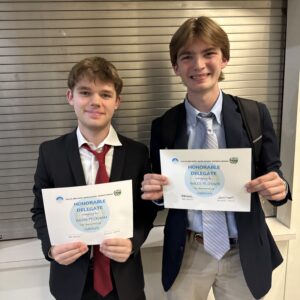
Then the moment came, our nation, Djibouti, in the Arab League, was awarded the Honorable Delegate award. Adam and I were honestly thrilled and proud. All the hours of research, position papers, and strategizing had paid off, and it felt great to see our efforts recognized. After the ceremony, we packed up, left the conference around 6 PM, and looked back on the day knowing we’d learned a ton, had a blast, and made memories we won’t forget.”
A Success
DAMUN 2025 was an incredible experience for Jesuit’s Model United Nations team. The conference challenged us to think critically, negotiate strategically, and work closely as a team, all while representing our assigned countries with confidence. Walking away with awards, like our Honorable Delegate recognition for Djibouti, was an exciting validation of all the preparation and effort we put in. Beyond the awards, the experience strengthened our skills, deepened our understanding of global issues, and brought the team closer together. With so much momentum, we’re excited for future conferences and can’t wait to see what our Jesuit delegates accomplish next. And as always, GO RANGERS!
Stay tuned into The Roundup for more updates on the Jesuit Model UN team as they continue to make an impact on the world stage!