


“Do not go gentle into that good night. Old age should burn and rave at the close of day. Rage, rage against the dying of the light”
Blight has swept across the globe like a slow-moving plague, stripping field after field of the crops that once sustained billions. Intense dust storms cloud the skies, turning daylight into a dim, rust-colored haze and leaving towns sprinkled with powdery remains of dead soil. Humanity is facing the imminent threat of extinction, staring down the terrifying reality of a planet that can no longer support it. When every solution on Earth has already failed, when staying means dying, you’re forced to think outside of the box. What would you do?
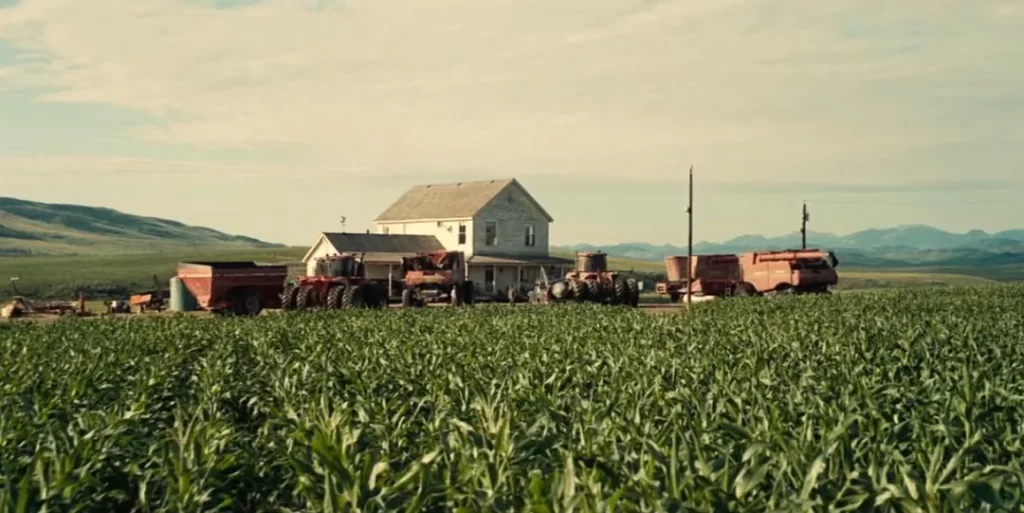
Released in 2014 by renowned director Christopher Nolan, Interstellar is a suspenseful, dramatic science fiction film that dives deep into the complexities of theoretical physics, astronomy, and human emotion. Starring Matthew McConaughey, Anne Hathaway, and Jessica Chastain, the movie perfectly captures the invaluable nature of human connection and familial relationships, while putting the existence of humanity in the context of the greater universe–something more vast and complex than we could ever imagine. In this movie review, I will dive into Interstellar’s groundbreaking cinematography, ingenious character development, perfectly complex plot, and real scientific discovery.
What is the Movie About?
Cooper, referred to as “Coop”, is a former NASA pilot and the protagonist of the film. He lives with his daughter Murph, son Tom, and father-in-law Donald, and with such high demand for crops, he works as a farmer. Murph is convinced that there is a “ghost” that is trying to communicate with her through supernatural gravitational anomalies in her room – random books falling off of her shelf in the middle of the night. These freakish anomalies continue, until finally, Coop and Murph decipher dust patterns that lead them to a secret NASA facility. Professor Brand – a scientist, astronaut, and expert in biology and planetary habitability – reveals to Coop NASA’s plan to save humanity. With the inexplicable appearance of a wormhole in space, there is potentially a shortcut to another galaxy possibly containing habitable planets. Because of his past experience as a pilot, Brand asks Coop to accompany them on their mission. He accepts.
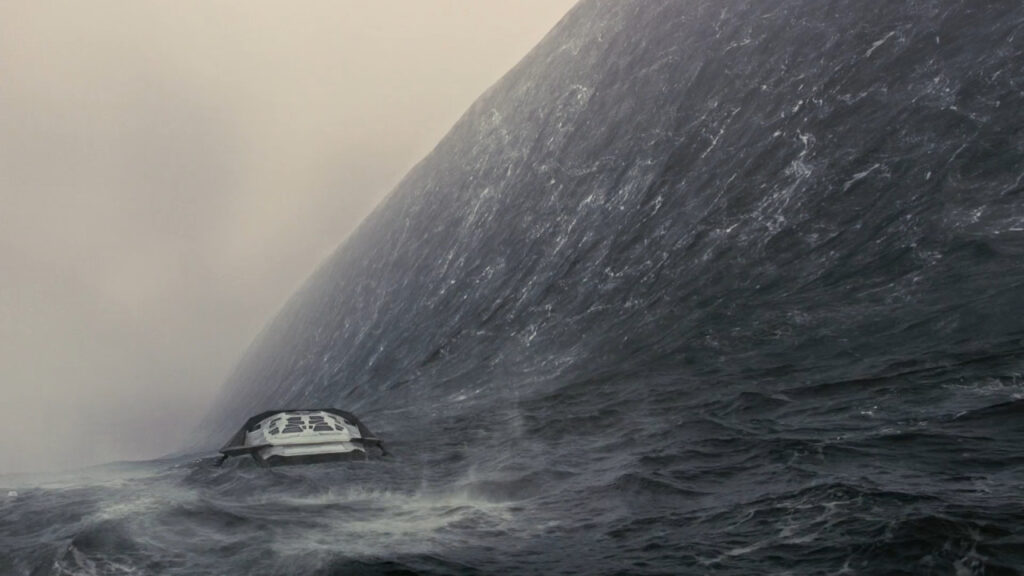
Alongside many decorated scientists and advanced robots TARS and CASE, the astronauts set out to explore three planets that were previously investigated on the “Lazarus Missions”, where earlier scientists sent data back to earth from planets orbiting a massive black hole named Gargantua. On Miller’s planet, the first planet that Coop visits, their proximity to the black hole creates the issue of time dilation. One hour on Miller’s planet is equivalent to years on Earth. Deadly tidal waves kill one of the astronauts and costs them decades of time on earth. When they returned to the main ship from their mission, Romilly – the astronaut who stayed back – had aged 23 years. Back on earth, Murph grew up to be a brilliant scientist working for NASA, and she discovers that Brand’s plan to evacuate humans from Earth was impossible, and the real plan was always to abandon Earth and repopulate a new world with embryos.
Coop and the other astronauts advance to the second planet, Mann’s planet, which showed the most promising data of potentially supporting human life. Upon touching down, they realize that Mann falsified his data and the planet was not sustainable. Mann, acting out of desperation, tries stealing Coop’s ship, causing a deadly confrontation that destroys part of the ship and kills Mann.
Running low on fuel and resources, Coop concocts a plan to “slingshot” around the black hole to get to Edmunds’ planet, the final planet and the last hope at re-populating humanity. However, the only way to travel that distance is for Coop and TARS to detach to lighten the ship. Coop falls into Gargantua, and instead of being torn apart, he enters a four-dimensional space created by the mysterious beings who placed the wormhole, future humans who evolved beyond our current understanding of time and space.
While in the tesseract, Coop discovers that he can communicate through gravity with Murph, crossing barriers of time and space. He realizes that he was her “ghost.” Through morse code and gravitational pulses, he transmits the quantum information that Murph needs to complete the gravitational equation, the final step to fulfilling “Plan A”, the plan to save the humans on Earth. Murph uses the data to solve the problem and the human race escapes the dying Earth. The tesseract collapses, ejecting Cooper, who is rescued near Saturn. He briefly reunites with his now elderly daughter. Murph tells Coop to find Brand, who is still stuck, alone on Edmunds’ planet. In the final moments of the film, we see that Brand has established a new foothold for humanity on Edmunds’ planet, and Coop steals a ship to join her, leaving the viewer questioning the next chapter of the development of the human race.

The Central Themes of Interstellar
The first main theme is the tension between humanity’s survival and the preservation of personal relationships. This broad idea is more concretely visualized through the options of “Plan A” and “Plan B”. Plan A is the ideal resolution, to take the humans that are currently on Earth and evacuate them to a habitable, healthy planet. Plan B is the more realistic, yet troubling option: Leaving the humans on earth to die and starting a new human population with embryos on Coop’s spaceship. Despite not knowing about the existence of Plan B, Coop’s choice to embark on the mission left Murph with emotions of abandonment, as Murph thought he went on his mission knowing that humans on Earth would be left helpless. This adds complexity to Coop’s decision making throughout the film, knowing that the pursuit of their initial mission means the desertion of his daughter and loved ones.
Another key theme of Interstellar is Christopher Nolan’s play with time dilation and relativity. First off, the function of time as a scientific and a narrative device satisfies both the laws of physics and Einstein’s General Theory of Relativity. Additionally, Nolan is able to effectively use this device to add emotional depth to the plot, as the rapid passage of time in Coop’s mission lingers as a troubling reminder of familial disconnection. Somehow balancing both effective plot implementation with a realistic inclusion of scientific principles, time dilation and relativity perfectly epitomizes the film as a whole – the ideal mix of astronomical truth and creative filmmaking.
Throughout the film, love surfaces as not just an emotion, but an intuitive force, a dimension. In the tesseract, Cooper communicates with Murph not through speech or technology, but by affection-driven intention amplified through gravitational anomalies. These anomalies become the mechanism through which future humans create a link between two points in spacetime. In this sense, Nolan frames love as the bridge through which the characters can realize a higher understanding and manipulate physical space beyond typical human power. Not to mention, Nolan parallels the scientific force of gravity with the concept of love. Gravity and love are both the only forces capable of crossing dimensions, warping space, dilating time, and reaching across extensive distances. Gravity operates as an invisible influence, not a direct force. If gravity can act across time, why can’t emotion? Nolan poses this question throughout all of Interstellar. Finally, love serves as a moral force, motivating self-sacrifice and driving connective innovation and persistence. Many drastic steps that Coop took throughout the movie wouldn’t have been possible without a fueling sense of love for those he would leave behind on Earth.
The final theme is the revival of the American frontier myth, the belief that humanity is largely defined by its courage to explore the unknown. In the dystopian setting of Interstellar, the film argues that the persistence of humanity depends on reclaiming this spirit of exploration, and the bravery to seek life beyond Earth. In this sense, the frontier myth functions as a source of hope, a reminder that with risk comes discovery, and with discovery comes progress. This hope serves as the engine of the plot, the sole mechanism by which characters are motivated to work. Cooper leaves his children because he believes that there is a future worth fighting for, and Murph’s work is fueled by a hope for her father’s return, and a hope that the gravitational equation can be solved. With the astronomical vastness of the film, Nolan reminds us that exploration becomes humanity’s greatest act of optimism, transcending physical obstacles to find a new home. Between this theme of exploration and the film’s scientific integrity, we are reminded that survival not only depends on ingenuity, but on the enduring hope of success.
The Scientific Accuracy of Interstellar
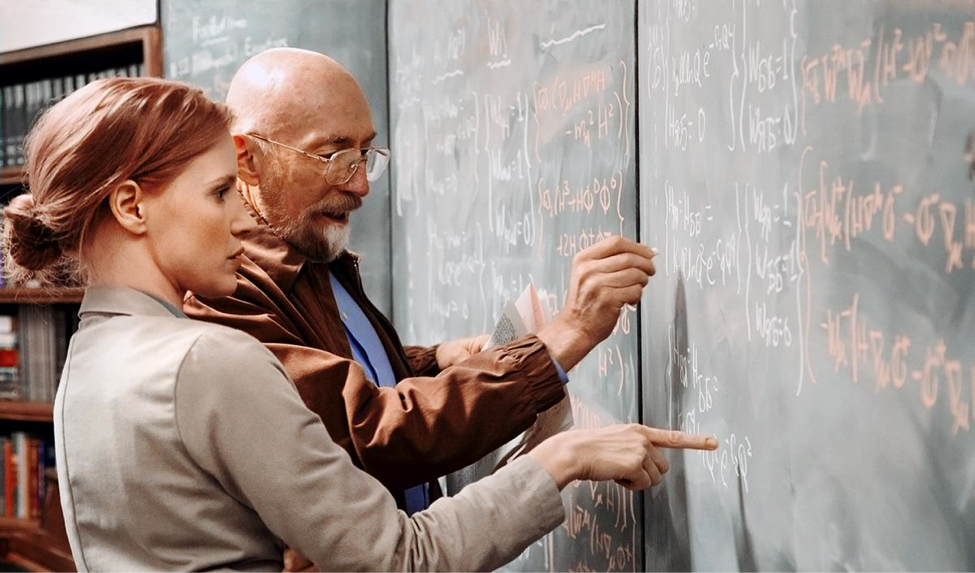
Interstellar has cemented its position as one of the greatest movies of all time, and it did so by generally adhering to existing laws of physics. More simply put, the movie isn’t all too unrealistic, and all of the generated images and cinematography are rooted in scientific truth. Kip Thorn is an American theoretical physicist, and the mastermind behind the science of Interstellar. Most prominently, Kip Thorne worked to generate three dimensional images of the black hole, Gargantua, for the film. Using existing two dimensional images, he was able to theorize how the structure would look in greater detail, and scientists in real life were able to take these images from the movie to make tangible progress on black hole theory. This is one of the many ways in which the creative minds behind the production of Interstellar contributed to actual discovery and progress in the field of astrophysics. And fun fact, each frame of Gargantua in the movie took roughly 100 hours to render due to the realism of the images, which accounted for all of Einstein’s equations regarding black holes.
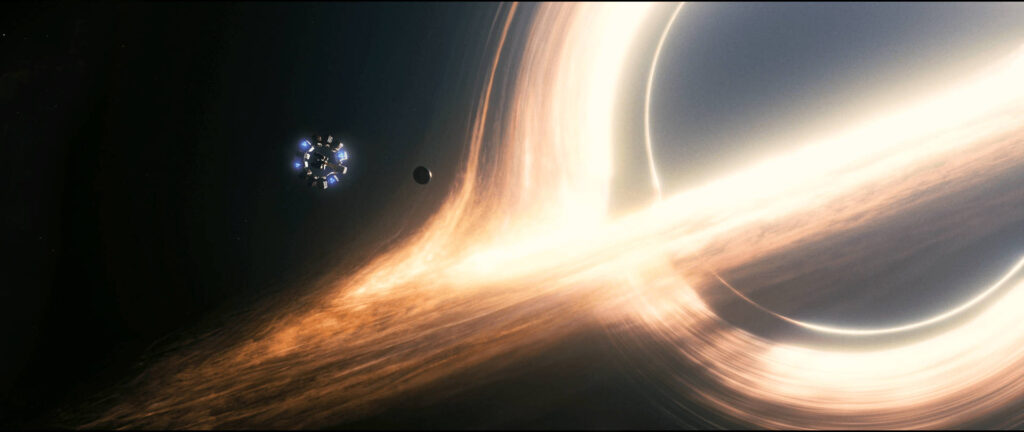
Beyond graphic realism, Nolan was intentional in perfecting the film’s interpretation of time dilation. While on Miller’s planet, one hour for Coop and the other astronauts is equivalent to roughly seven years on Earth. In the movie, you can hear a faint ticking sound effect in the background of each scene on Miller’s planet. At first viewing, these ticks simply complement the intensity of the planet’s atmosphere, but in reality, each tick is exactly 1.25 seconds apart from the next, marking one full day that has passed on Earth. This detail serves as a constant reminder of wasted time and the approaching demise of planet Earth, and further contrasts the safe option of “Plan B” with the more fruitful, yet dicey “Plan A”.
Cinematography, Setting, and Score
All of Interstellar was shot through IMAX filming, which allowed for higher quality and the full development of detailed shots and scenery. Also, the setting of Coop’s home farm on Earth was shot near mountain ranges in Canada. Workers on the set of Interstellar went out of their way to plant 500 acres of corn fields on open land in Canada near mountain ranges, rather than filming at pre-existing farms. Why put all the time and effort into staging farmland near mountains? Christopher Nolan wanted to emphasize the desperation of the human race, and the true scarcity of natural resources. In this dystopian world, the demand for food is so high that farmers are forced to cultivate land in unideal geographic locations, such as near the mountainside. The faintly unsettling proximity of snowy mountains and corn fields adds to the tension of the film, crafting a never-before-seen culmination of individually-familiar geographic characteristics.
Finally, Nolan recruited Hanz Zimmer, German composer, to create the music for the film. Interestingly, in writing the core theme to Interstellar, Nolan only gave Zimmer a brief one page document briefly detailing a father-daughter relationship. Nolan didn’t give any details about the plot of the movie because he wanted to keep the music organic, intimate, and reflective of the movie’s fundamental focus: the salvaging of human connection. Within such a chaotic and overwhelming plot, the music helps to re-center the viewer in its incredible simplicity, as all of the songs are composed primarily of organs and strings.
The Significance of Interstellar
Interstellar managed to blend scientific exploration with authentic, relatable human emotion in a way that few films ever have. The film serves as a reminder that exploration is a deeply human pursuit powered by love, hope, and innovation, not merely a technological endeavor. The transcendent nature of love throughout the film reminds us that the connectivity of humanity reigns supreme over any physical and emotional barriers, barriers among planets, nations, states, and people.
“Do not go gentle into that good night. Old age should burn and rave at the close of day. Rage, rage against the dying of the light”
Whether on Earth or in space, man’s spirit was made to endure–and to explore.
