


Southern France is known for its Mediterranean beauty, ancient history, and deep culture. The area broadly consists of the regions of Provence and Occitanie, which have a different feel from the rest of France. In this article, I will explore what makes Southern France special by explaining key cities, sights, and cultural characteristics.
General Information
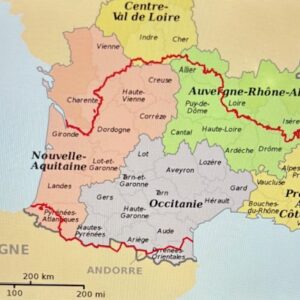
To start, I will explain the area. Provence and Occitanie stretch from the Franco-Italian border to the Franco-Spanish border and are the only regions in France that are along the Mediterranean Sea. Besides being coastal, these regions are very mountainous, with Provence containing some of the Alps and Occitanie containing some of the Pyrenees Mountains. The Rhône River, one of the largest and most important rivers in France, cuts straight through the heart of Provence and has been used since ancient times as a means of travel and commerce. Being on the Mediterranean Sea, both regions have a Mediterranean climate with temperatures on average ranging from 40°F in the winter to 90°F in the summer. The regions are mostly sunny with the occasional rain shower, and the climate tends to be dryer in the areas furthest from the coast. Southern France is also famous for its wine which is a major industry and tourist attraction due to the Mediterranean climate. The people in the regions predominantly speak French and the primary religion is Roman Catholicism.
Nice
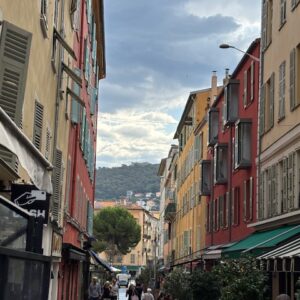
One of the major cities in Provence is Nice. Nice is known for its unique beauty, with colorful pastel buildings contrasting with an idyllic beachfront

with lush hills in the background. Located close to the Italian border, Nice contains a unique fusion of French and Italian cultures and cuisines. Nice is a ritzy city in the center of the Côte d’Azur, the flashiest and prettiest part of the French Riviera, which is why many rich people vacation here. Apart from the beach, Nice has long been a magnet for great artists inspired by the unique lighting and scenery of the city. As a result, Nice has many great art museums of artists such as Chagall and Matisse. Additionally, Nice has a fantastic old town with beautiful buildings and a wonderful cathedral: the Cathedrale Sainte Reparate. One can also climb up to Castle Hill to get a wonderful view of the city below. Nice is also known for its Bouillabaisse, a classic seafood dish, like a fish stew, from Southern France.
Monaco
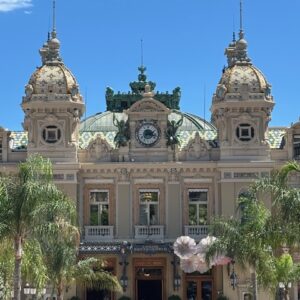
Although not in France, one of the most visited cities in the French Riviera is Monaco. The city-state, the second smallest country in the world after Vatican City, is mostly known for its wealthy royals and casinos. The Casino Monte Carlo is probably the most famous casino in the world, and is where the wealthy love to gamble. Monaco is also a place where the rich love to flaunt their wealth by showcasing their massive yachts and expensive sports cars. Additionally, the Monégasque royal family live in a famous and glitzy palace overlooking the country. Monaco is also famous for its Grand Prix, probably the most well known race in all of F1, which brings in tons of tourists and lots of mega yachts. Apart from all the glamor, Monaco has an attractive, be it small, old town with tight streets and the beautiful pastel buildings emblematic of the French Riviera.
Cannes
Much like Monaco, the coastal French city of Cannes is also a magnet for the very wealthy. The city is known mostly for its world famous film festival which attracts movie stars and tourists from all over the world. As a result, Cannes has a very famous movie theater and red carpet where one can tour or see the famous actors during the festival. Cannes also has many charming buildings in the same pastel, beige, and red tile style as the other cities located on the Côte d’Azur. Otherwise, Cannes is known for its great beaches, high end restaurants and stores, great climate, super yachts, and sports cars.

Aix-en-Provence
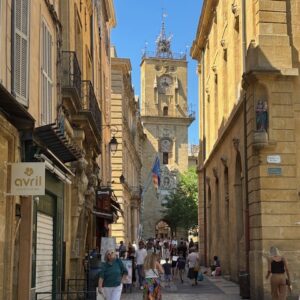
Away from the glitzy Côte d’Azur and into the interior of Provence, one can visit the city of Aix-en-Provence, the old capital of the region. It is a charming little city home to a beautiful and thriving medieval town. Aix-en-Provence is a wonderful place to stroll around and shop at one of its many great stores, restaurants, or bakeries the city has to offer. The city also has a wonderful cathedral (the Cathedrale Saint-Sauveur) which houses a lot of beautiful medieval religious art.
Nîmes
Another famous city in Provence is Nîmes, which is home to many impressive Roman ruins. In fact, some even call the city “French Rome.” In the center of the city lies the massive Arena of Nîmes, one of the most complete Roman amphitheaters in the world. The Arena looks like a smaller version of the Coliseum in Rome and is still used today for bull fights.

Additionally, Nîmes is home to the Maison Carrée, one of the best-preserved Roman temples. The temple, dedicated to some deceased Roman nobility, is one of the top attractions in the city and has inspired many buildings around the globe including the state capitol building of Virginia. Nîmes is also known for the Tour Magne, a famous old Roman watch tower perched upon the top of a hill. It is still possible to go to the top of the tower, and from there one is greeted with great views of the city below them. Lastly, just outside of Nîmes one can drive to the Pont du Gard, which is a massive section of an old Roman aqueduct that still stands. The structure is stunning and is accompanied by a great museum explaining the history and building of the aqueduct in ancient times.

Avignon
Avignon is also a city rich in history, just not so much of the Roman type. The city is famous for being home to the Catholic Church and 7 popes during the Avignon Papacy, a period from about 1309 to 1377 where the Church was led in Avignon rather than Rome. When the papacy eventually returned to Rome, it triggered the Great Western Schism where two different people, one in Rome and one in Avignon, claimed to be pope. In modern times however, a lot is left over from the time the Church was centered in Avignon, including a massive papal palace and a wonderful cathedral. The papal palace dominates the city and provides a great museum of the Avignon papacy. The palace also gives its guests great views of the city below. Avignon Cathedral, dedicated to the Virgin Mary, is a beautiful medieval church containing many impressive statues and paintings. Avignon also contains a famous incomplete medieval bridge, the Pont Saint Bénézet, which would have been a massive structure crossing over the entirety of the wide Rhône river, impressive for that time.

Carcassonne
Another great medieval city is that of Carcassonne. The old city is surrounded by thick stone walls and is perched on a little hill surrounding the more modern city below. In the center of the old city lies the Chateau de Carcassonne, an old castle. The castle is well preserved and a great visual for what other medieval castles would have looked like across Europe. The castle is very defensible with large stone block walls and many holes to shoot out arrows in case of attack. Additionally, the city contains the Basilique Saint-Nazaire, a medieval stone basilica that is a perfect example of medieval religious architecture in France. One can also walk the long outer stone walls and visualize what it would have been like to be a guard of the city. Walking along the walls also provides spectacular views of both the old city inside the walls and new city outside the walls.

Conclusion
Overall, Southern France is a wonderful place to visit and is rich in history and culture. From the glitz of Nice and Cannes to the Roman ruins in Nîmes and the medieval history of Avignon and Carcassonne, Southern France has something for everybody and remains one of the most beautiful places on earth.
