


“I don’t want you to come out of this experience feeling thankful for what you have,” said Dr. Michael Reimer during student reflection, “but I want you to gain an understanding of their lives along with yours.” His words struck within myself and my peers as we gained a new perspective on what we were truly experiencing.
Throughout the school year and the summer, Jesuit Dallas offers many service opportunities which involve traveling out of state or to a different country to participate in service. One trip offered is an opportunity to work with The Quispicanchi Project. During the summer of 2025, Jesuit Dallas offered two service opportunities with the organization. Created by past Jesuit teacher, Dr. Michael Reimer, the Quispicanchi project takes students to Andahuaylillas, Peru to immerse themselves in the community, participate in active service projects, and develop their understanding of faith. The trip itself is split into two sections, the first being the service aspect and the second containing an exploration of Peruvian culture.
About the Quispicanchi Program:
“The Quispicanchi (kiss-pea-khan-chee) Project is the result of years of relationship development with the people living in the Quispicanchi Province of Southern Peru. We are a cohort of former short and long-term volunteers who have been deeply impacted by our time living in these communities. Some of us are currently serving in US-based non-profits, some in the classroom as teachers and students, and others of us are young professionals. Collectively, we realize that the relationships we began during our service in the region compel us to take action. Through this effort, we desire to continue to dwell in a mutuality of grace and love.”
-Quispicanchi Project website
The Quispicanchi Project works directly with the community to help serve their needs. For example, the Quispicanchi Project wanted to address the high anemia rates observed by people living in Sullumayo, a region isolated in the mountains of Peru. Anemia is caused by a lack of nutritional diversity. Since Sullumayo is in the mountains with rocky environments, it is hard to grow crops and raise livestock. In response, the Quispicanchi Project provided the people with chickens along with gardens to grow rice crops and potatoes. By doing this, the Quispicanchi Project has successfully gotten rid of almost all the cases of anemia for the students that attend the school in Sullumayo. The project has also created a successful dental awareness program that has been reached out to on multiple occasions to instruct people on how to properly take care of their dental hygiene.
Besides providing resources through projects, the Quispicanchi Project enlists volunteers from colleges across the nation to work with them as service ambassadors. The college volunteers live together in a shared home where they rest and have meals with one another. The project simulates similar living conditions to the poverty inflicted community around them by rationing their weekly income, forcing the volunteers to make intentional purchases and conserve money where they can. Each day, the volunteers are sent to designated schools where they help take care of, teach, and interact with the students. After attending the schools and helping throughout the day, the volunteers then interact with the students in after school programs, events, or among the community. Through this schedule, the Quispicanchi Program allows the volunteers to serve the community by becoming a part of it themselves.
Serving in Andahuaylillas
Before this trip I had never experienced anything like a service trip before, much less been out of the country without my parents. I had not even registered at the official deadline and only applied after hearing of extra openings that Mrs. Farrell told my AP Literature class about. Even though I was hesitant about taking up this opportunity, I decided to go on the trip regardless of my fears.
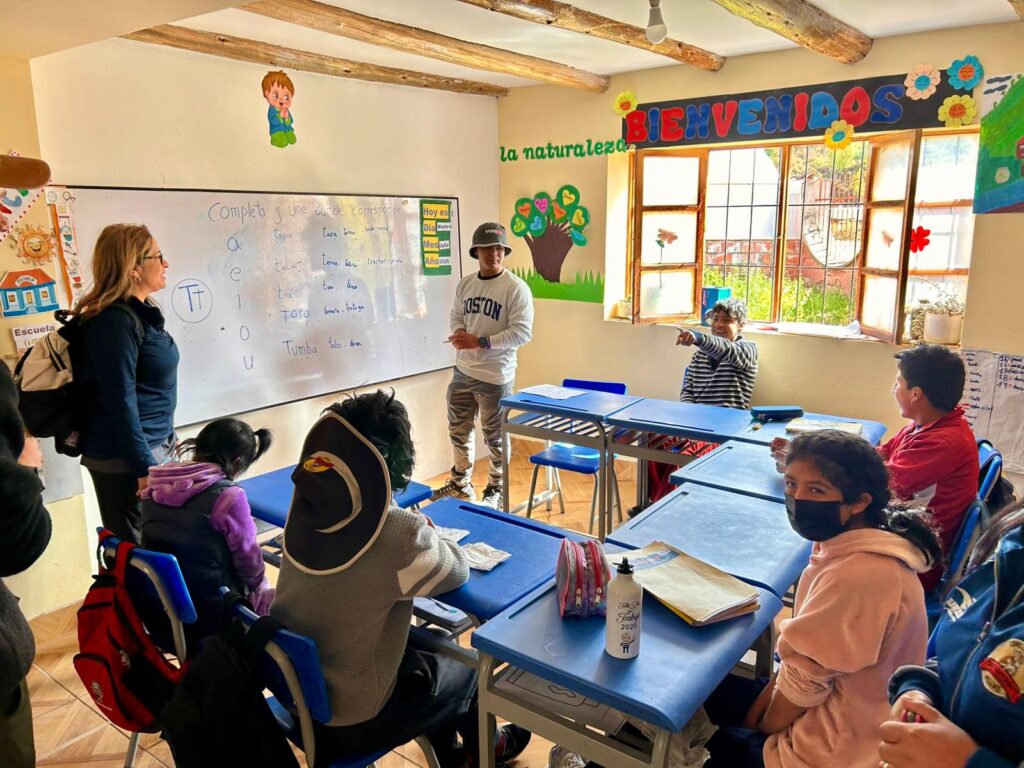
Contrary to my prior fears, the trip was one of the best experiences that I have ever had. One of my favorite activities was traveling to different schools and getting to meet the children there. One such school was the San Antonio school, a school that taught and took care of kids with special needs. This ranged from students with down syndrome, autism, or any other special condition. I was assigned to the third and fourth grade class where they were learning words that began with T. When I initially arrived, my presence was not entirely welcome by the students, with some of them poking fun at my mispronunciations in Spanish. The teacher, sensing my uneasiness, invited me to sit at a desk and learn with the students. So I learned with them and offered some words that I knew that began with T in Spanish. Eventually, the students learned that I spoke English and asked if I would teach them some words in English. They seemed excited about the prospect of learning English, so with the permission of the teacher, I taught them some words in English. The students seemed to really enjoy my teachings and cheered when they said a word correctly. After we finished at the school, some of the kids gave me a hug before leaving, and I felt that I had truly made an impact on them.
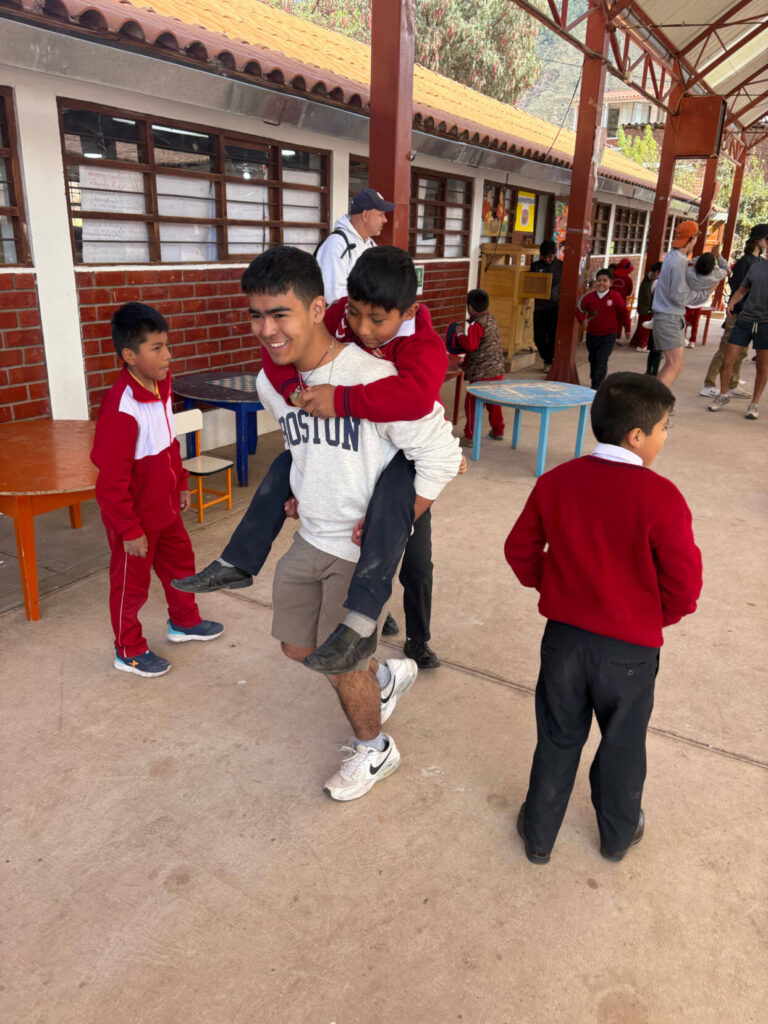
Traveling to these schools also taught me how to serve others in a different way. At Jesuit Dallas, I participated in the Brothers For Others program which works with service organizations that take care of individuals with special needs. Oftentimes, these service sites have facilities that aid them in taking care of these people. However, in Peru, not everyone has access to the same facilities. At the San Antonio school, I had to learn how to interact with the children in a different way. One experience with a student that stuck out to me was my time with a girl named Jessica who had down syndrome and blindness. At the time, we were working on coloring a page and she needed help coloring on the page. I observed her teacher as she guided her hand across the paper to help her color. After the teacher asked me to take over for her, I tried to do the same thing. However, Jessica kept trying to push me away. Sensing her discomfort, I asked the teacher why she kept trying to push me away. Although I could not understand every word that the teacher said to me, I gathered that she did not trust me and that I was being too forceful. She said that I should instead try to work with her rather than trying to make her do a certain thing. With this in mind, I altered my approach and yielded much success. We finished her coloring and even got to dance with the other students. She did not push me again after I switched my approach and I was glad to have gained her trust.
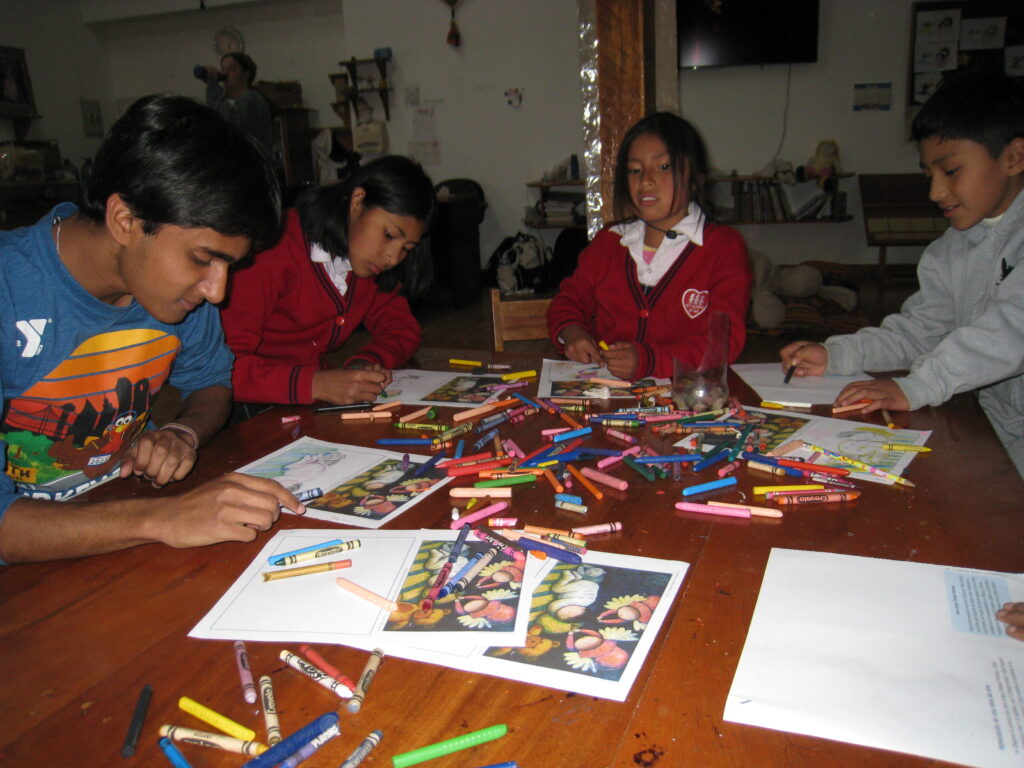
Outside of going to the schools, there were a lot of after school programs where we got to hang out and play with the kids. In the plaza of our parish, we would find students from nearby schools playing soccer and basketball, or talking and listening to music. Some kids went to after school programs where they did arts and crafts. It was fun to interact with the kids in a less professional setting as we got to have fun and learn more about them.
In the evenings, to conclude our day, we would have reflections about what we experienced that day and often read over a passage and scripture. The reflections were helpful to all of us as we enjoyed sharing our experiences throughout the day and often finding common ground in the experiences we had. Tying our daily experiences to the lessons and scriptures being taught not only gave us an appreciation for our interactions, but also provided us with insight about our faith.
Exploring the Culture of Peru
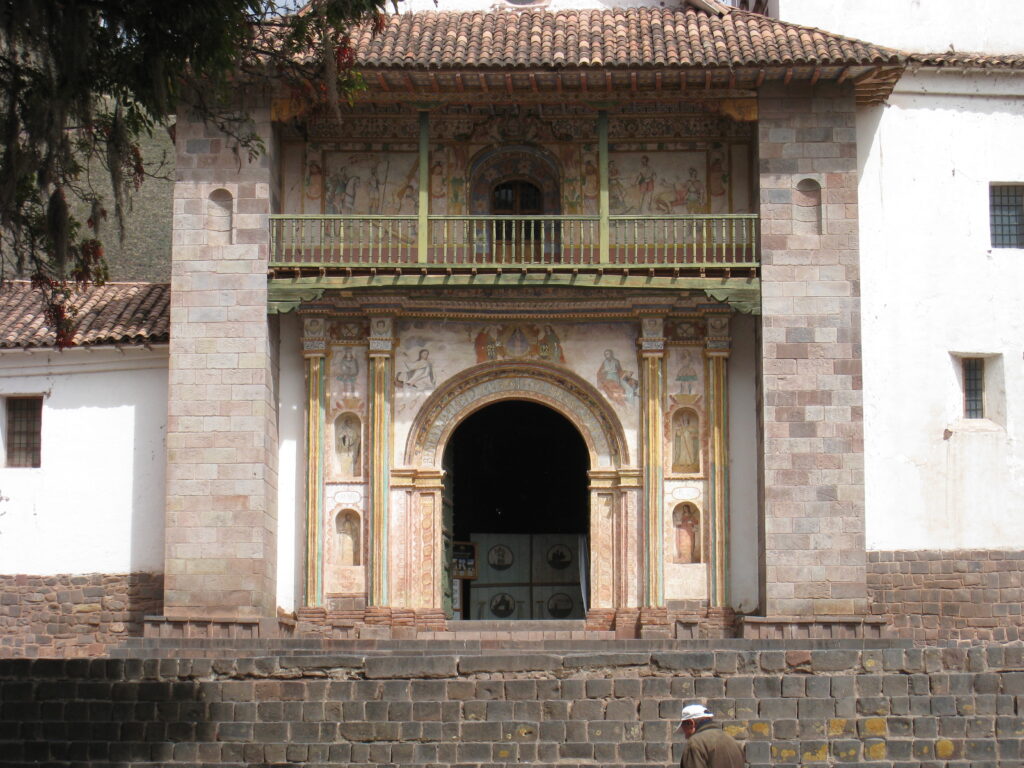
Throughout portions of our time in Andahuaylillas, we got to explore and experience aspects of Peruvian culture. For example, just outside our parish in the village we stayed in was an elaborate church. The San Pedro Apóstol de Andahuaylillas Church was built by the Spanish when they initially arrived in Peru. Due to a language barrier between the indigenous peoples and the Spanish, the missionaries decided to utilize artwork to help convey their message to the indigenous people. Inside the church, there are many paintings, mosaics, and architecture that convey important church aspects. In this way, they were able to communicate with the indigenous people without the use of words. Inside the church, you could also observe a blending of cultures present. One archway featured four languages: those being Spanish, Quechua (the native language of the region), Latin, and another indigenous language that has since been lost to time. As well as a mixture of language, the architecture features a blending of Spanish styles, as well as indigenous aspects. For example, the altar is elaborately decorated with gold, silver, and mirrors. The gold represents the sun god, the silver represents the moon god, and the mirrors represent the ocean/river god. Their incorporation in the design of the altar shows a blend of both Spanish and indigenous cultures.
Alongside the church, the village also featured a weaving ground where people could come and use looms to weave. There, they create shirts, sweaters, bracelets, ponchos, and other goods that they then sell in the market. As part of our trip, we got an opportunity to learn how to weave a basic bracelet. Some indigenous women took us aside and taught us how to properly make the bracelets by hand, and then supervised us while we made our own. Despite its apparent easiness, creating the bracelet took a lot of effort, especially while trying to avoid mistakes. I gained a newfound appreciation for all the bracelets I bought on the trip seeing how difficult a simple bracelet was to make.
Outside of Andahuaylillas
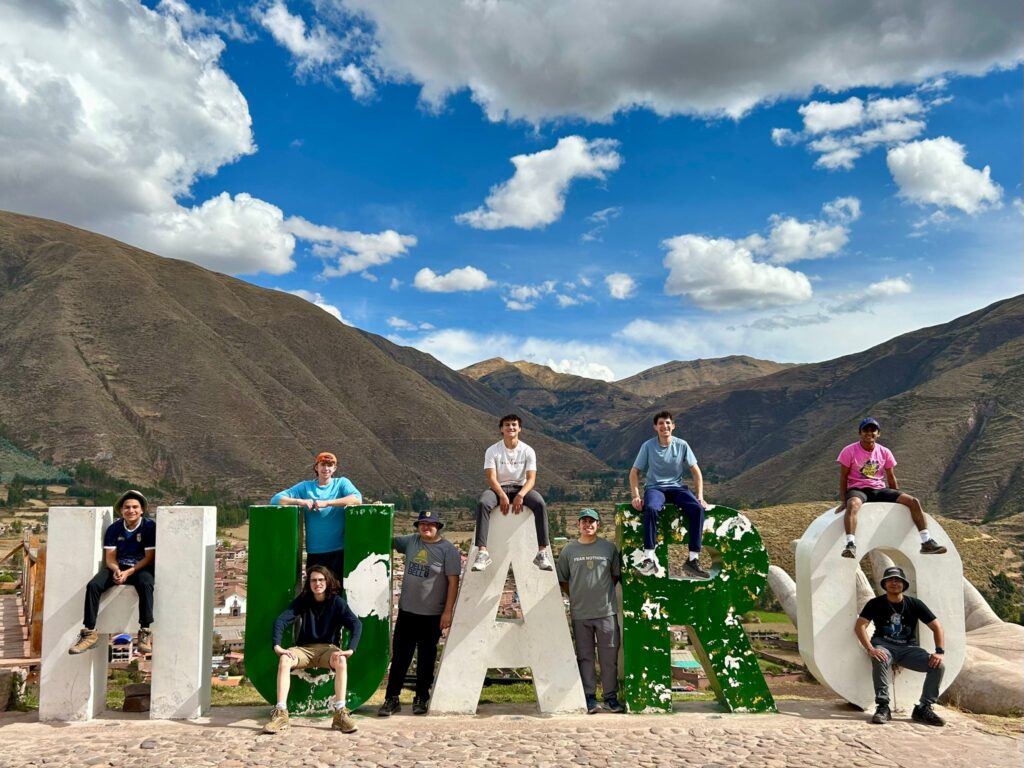
Following the service portion of our trip, we got to explore other parts of Peruvian culture including some architectural sites. One such site was Ollantaytambo village, an old fortress and temple overlooking the village. It is believed that this site is supposed to be shaped like an alpaca, which had an important cultural significance to the indigenous people. This site featured terraces and ancient stones harvested from mountains miles away. It’s a wonder how they were able to transfer the rocks far. After reaching the top of the temple, I was in awe of the view of both the town below and the vast mountains and valleys surrounding the place. The view was nothing like I had ever seen in the United States and I was in disbelief by the sights around us.
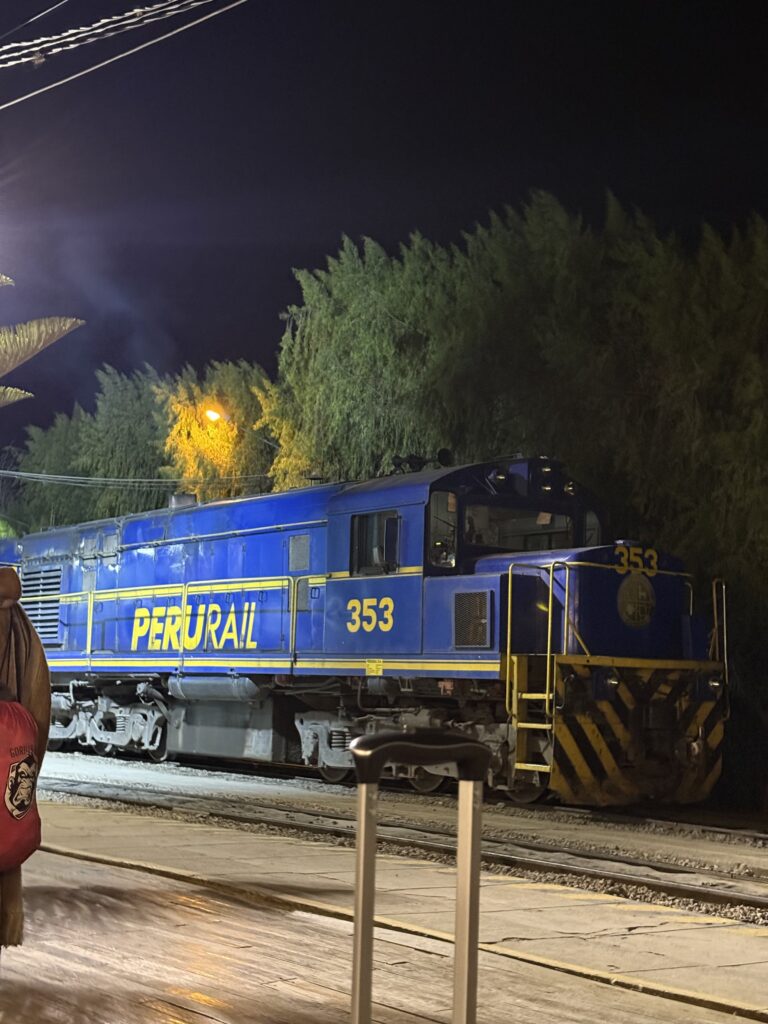
Following our visit to Ollantaytambo, we had to take a train to Aguas Calientes, the place we were staying before we visited Machu Picchu. On the train ride, we got to see further views from the train. Unlike Texas, the region of Peru we were in contained a plethora of mountains and valleys. Simply looking around provided a view at almost every angle. Ensnared by the beauty of the land, I could pass the time on the train by simply looking around at the sights.
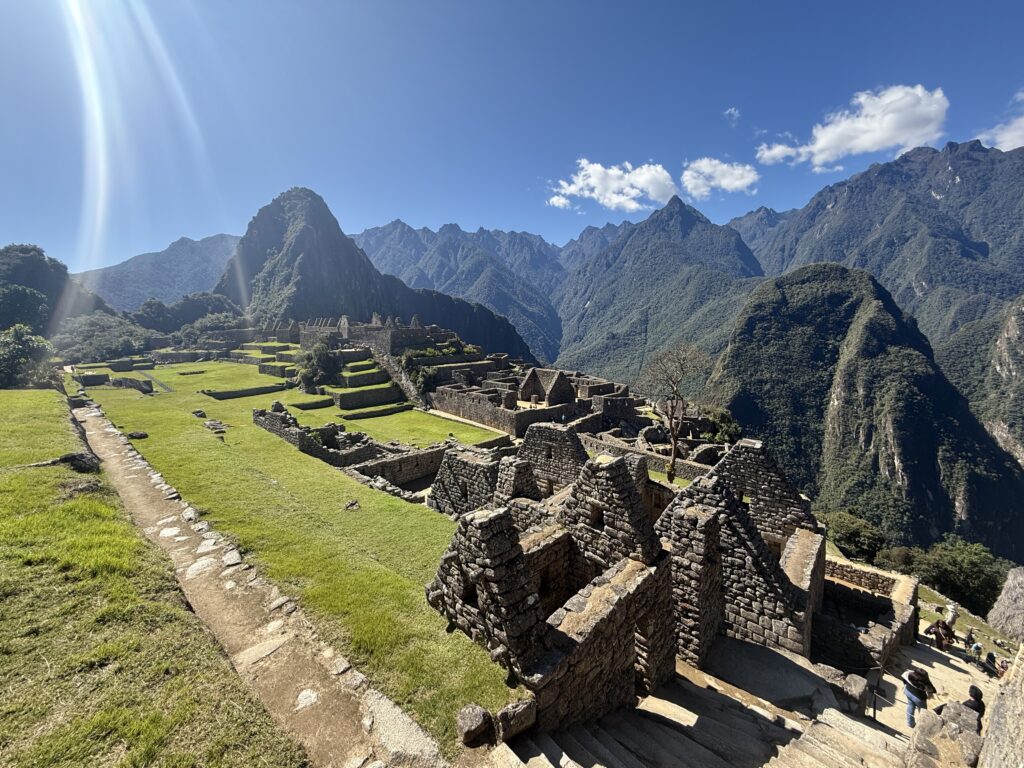
The following day, we took a bus up to Machu Picchu where we got to see the peaks of some of the larger mountains in the region. Even looking out at the jungle landscape brought awe to all of us in the bus, each clamoring to get a shot of the view around us. When we arrived at the top, we got to explore the architecture around the ruins as well as explore inside the ruins themselves. Inside the ruins were ancient cultural remnants like altars and statues. Listening to our tour guide, Alejandro, we got to learn even more about the ancient Incan culture in the area and learn about aspects of the ruins we could not identify at first sight. Exploring the ruins for less than a day, I came to understand why this sight is so popular to visit.
Concluding Thoughts
Sam Creighton ‘26 had this to share about his experience on the trip:
“The experience was overall really impactful for me. I saw how much joy the community kids had when I would do something as simple as play soccer or basketball with them, help them draw, make bracelets, etc. Furthermore, the students taught me many valuable lessons. They were so happy with so little and were always smiling and laughing. I truly felt I could see God through the students I worked with and was able to truly connect with them on a deep level, which surpassed my occasional language barrier with them. It was amazing that I was able to learn such profound lessons from them while simultaneously serving and helping them. The trip taught me that the value of serving comes in encountering others in a meaningful way. I learned that true service isn’t about constantly trying to teach and help, but rather meeting people where they are at and connecting with them on a deeper level, through sharing meaningful moments and engaging authentically. Through this experience, I felt that I had not only made an impact but had also been deeply impacted in return.”
Going into the 2025-2026 school year, the school announced that the theme of the year would be Building Community. From my time in Peru, I experienced how great it feels to become part of a community of people. The structure of the trip puts you in a position to be directly exposed to the community and oftentimes encourages you to interact and build connections with the people that you meet. Staying in the parish and traveling around the different schools showed us the benefits of being surrounded by a loving community. As Dr. Reimer invited us to consider when we first arrived, we were not just there to serve the people, but the people around us were also serving us in the community that we became a part of.
