


Located within the 29,000 square foot state-of-the-art Gull, Jesuit’s natatorium features a 5,650 square foot competition pool equipped with two 1-meter diving boards. It is the only natatorium in the private school corridor of Dallas that provides students with the opportunity to learn and compete in diving. Under the leadership of Head Coach Sierra Thain, the diving program at Jesuit has evolved and gained significant recognition throughout the Dallas Metroplex by other private and UIL 6A public schools.
Recently, I had the opportunity to gain insight into the diving program by interviewing Coach Thain about her background and the fundamentals of this talented and emerging team. Additionally, I conducted a brief profile on Divers Koby Broad ’28 and Kobus Brewton ’28 and included results from the recent diving competition during the Swimming and Diving meet against Bishop Lynch on September 11.
Head Coach Thain – Her Journey to Becoming Jesuit’s Head Coach
Head Coach Sierra Thain comes with an impressive background in both diving and gymnastics. Her experience in gymnastics, a sport that closely relates to Diving due to both requiring flexibility and technical precision, has greatly influenced her coaching. Here, she shares her insights on how she entered the world of diving.
“My athletic journey began in gymnastics at the age of four, and by eighth grade, I had earned a spot among the top 100 gymnasts in the country. After years of competitive success and podium placements, I competed at Junior Olympic Nationals before deciding to step away from the sport. I began competitive diving during my sophomore year of high school where I quickly advanced to the Junior Olympic level. Throughout high school, I earned placements at UIL District and Regional meets, along with strong performances at various competitions. My progress in diving led to an NCAA Division I athletic scholarship, allowing me to continue my athletic career at the collegiate level.
I began coaching gymnastics in 2015, and during college, I expanded my coaching experience to include diving. After graduating, I knew I wanted to remain involved in the sport by continuing to coach.”

“I believe athletics plays a vital role in developing well-rounded individuals, fostering discipline, and bringing about a strong sense of inclusivity. As a coach, my goal is not only to support the development of each athlete but also help bring greater recognition to the sport of Diving.” -Coach thain
Questions About Jesuit Diving with Coach Thain
1-Meter Diving Competition
Below Coach Thain explains the process of a 1-Meter Diving Competition.
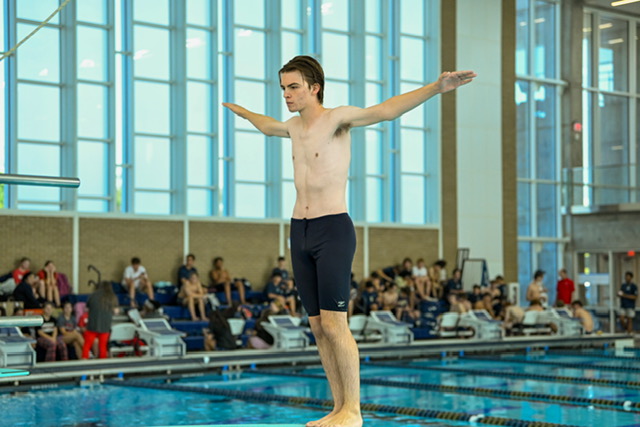
“A standard high school diving meet consists of six dives–one voluntary dive and five optional dives–selected from four of the five categories: front, back, reverse, inward, and twisters. The voluntary dive is generally the simpler dive from the category such as a basic dive or a 1.5 somersault as they carry a lower Degree of Difficulty (DD). Optional dives are more advanced and typically have the higher DD value on a diver’s list such as a 1.5 somersault or more complex such as double somersaults. Divers may not repeat any dive during the meet.
Each dive is scored on a scale of 0-10. Many elements are taken into consideration by the judges including the starting position, approach, hurdle, takeoff, flight, and entry. The average score for a well executed dive typically falls between 5 and 5.5.”
Listed below is the scoring table for a dive:
- 0 = failed dive
- .5-2 = unsatisfactory
- 2.5-4.5 = deficient
- 5-6.5 = satisfactory
- 7-8.5 = good
- 8.5-9.5 = very good
- 10 = excellent
“Each dive is given one score by three judges, those scores are then combined and multiplied by the dive’s specific degree of difficulty. The resulting score is then added to the scores of the diver’s other dives to calculate their final score for the meet. The diver’s placement receives a designated amount of points which are then added to the swim team’s overall score.”
What Athlete Do You Look for in Your Divers?
“As a coach, I look for athletes who demonstrate strong spatial awareness, show a willingness to learn, and embrace feedback. Equally important, I welcome athletes who may not have yet found their athletic niche but are eager to explore a new sport and discover opportunities for personal growth and development.”
How Does the Usual Diving Practice Run?
“Practices begin with a dryland workout that includes stretching and conditioning exercises. The divers then transition to the boards starting with line-ups to emphasize proper positioning and clean entries into the water. This is followed by hurdle drills and jumps which help develop balance, coordination, and approach mechanics. Each practice session is structured around one category and as divers demonstrate improvement, the complexity of the dives increases accordingly to allow progression in their degree of difficulty.”
What are You Looking Forward to this Upcoming Season Based on the Current Roster?
“The current team is off to a strong start; everybody has shown impressive progress since our first practice. With each new dive, the enthusiasm to learn the next one only grows. As a coach, what excites me most is watching their continued development–not just in the execution of the dives, but in the confidence they build as athletes along the way.”
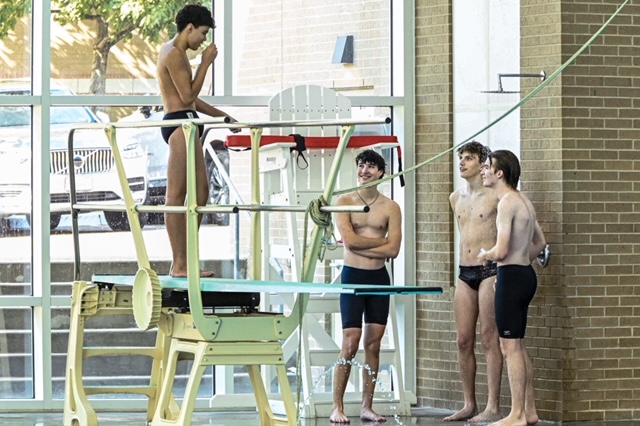
Student-Athlete Profile with Sophomores Koby Broad and Kobus Brewton
I recently asked Koby Broad and Kobus Brewton a few questions about their journeys and experiences with diving. Below are their responses during our interview.
Q: What interested you to dive at Jesuit?
Koby: I was interested in diving because of how little the team was. Additionally, me and my fellow teammate Kobus had both decided after seeing diving in action at [Jesuit’s] Ranger Relays that it was something that we could see ourselves participating in at Jesuit and the fun it could bring.
**Ranger Relays was hosted at SMU’s natatorium last year, and prior to the meet starting, there was a diving practice happening at the opposite end of the pool that swimmers were able to watch.**
Kobus: Dive first interested me when my friend Koby Broad and I were talking about how fun diving looks, so we decided why not join!
Q: How long have you been participating in diving?
Koby: I personally have been diving for almost eight months now, so almost a year.
Kobus: In October, I will have been diving for a year.
Q: What is your best dive?
Koby: My best dive is Back 1 and a Half on the 1-Meter.
Kobus: My best dives are my inwards, especially my inward dive pike.
Q: What are you looking forward to this season?
Koby: I am looking forward to having more teammates this season to share with the great experience that diving is at Jesuit thanks to our amazing coach and positive team environment.
Kobus: This season I am looking forward to Districts where I will get to compete in 11 different dives!
Bishop Lynch Dual Meet Results
This meet was technically an intrasquad competition for the divers since there were no divers from Bishop Lynch. Nevertheless, the team members competed vigorously and performed well, whether they were returning for another season or were new to the team.
Koby Broad ’28 secured first place with an impressive score of 165.10, marking a solid start to the new season. Kobus Brewton ’28, another fellow sophomore, finished in second place with a score of 153.55, and Senior Wills Blosser ’26 took third with a score of 110.45. New to the sport, Koen Mathys ’27 also showed promise, finishing close to the top competitors with a score of 95.95.
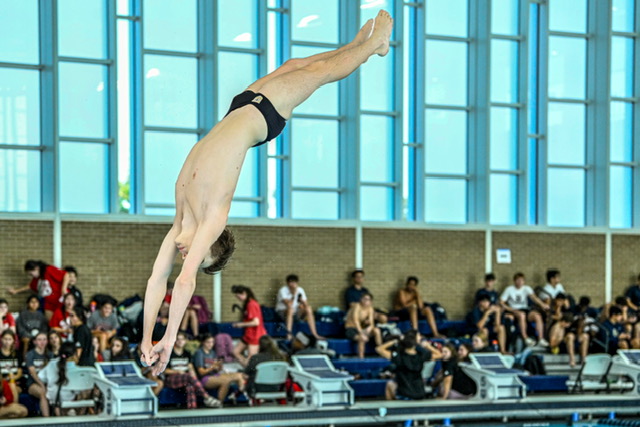
I want to express my gratitude to Coach Thain, Koby Broad, and Kobus Brewton for the insight they provided me with regarding Jesuit Diving. For the next part of the Diving season, Jesuit will head up to the Don Rodenbaugh Aquatics Center in Allen on October 14 to face-off against Allen and Lovejoy. To see the rest of the Swimming and Diving season, click on this link.
Tune into The Roundup for more Diving coverage!
