

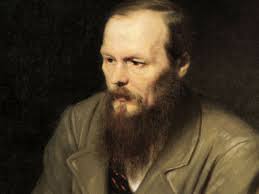
Born November 11, 1821, Fyodor Dostoevsky was an influential Russian philosopher and author who explored themes of religion, politics, and the human condition. He is agreed to be one of, if not the greatest novelist in world literature. His creations resonate deeply with all readers alike which grants him the nickname “The Philosopher of the Soul.”
Personal Life
Dostoevsky was born into a middle class family in Moscow with one brother. His father was a successful doctor who worked with the poorer people of Moscow, exposing young Fyodor to the lower class. His mother introduced him to Russian literature from the age of three. This is where Dostoevsky acclaims his great imagination originated from. Like most others in Russia at the time, he was raised eastern orthodox. In 1837, when he was 16, Dostoevsky’s mother died of tuberculosis. Two years later, his father also died. Fyodor’s young life shaped his bleak, yet sophisticated and intelligent writing style.

Throughout this time, he was away at academy where he later graduated and achieved the label of engineer cadet. His job as a lieutenant engineer was short lived. Since his first novel, Poor Folk, succeeded more than anticipated, he sent a letter asking to resign his post. He then experienced a short period of financial and health problems. However, he joined the utopian socialist, Beketov Circle, which helped him stay afloat. Later, he joined the Petrashevsky Circle, a group proposing social reform in Russia, but never by revolutionary means. On the contrary, one of the new members supported a revolutionary group that Dostoevsky was aware of. The Russian government sentenced them to the firing squad.
As the firing squad readied to fire, someone brought a letter from the tsar to reduce the sentence. Dostoevsky was then transferred to a Siberian prison camp. This imprisonment was harsh due to the fact that he was classified as “one of the most dangerous convicts,” and suffered more health issues and seizures. While in prison, he read the New Testament of The Bible, as well as works by Charles Dickens, which possibly influenced his literature.

Dostoevsky’s Philosophy
Dostoevsky’s long list of philosophical ideas is never-ending. It’s amazing how he is able to condense this amount of philosophy into finite amount of literature. Numerous philosophers such as Friedrich Nietzsche and Albert Camus base some of their philosophical ideas from Dostoevsky. This, of course, demonstrates the amount of influence Dostoevsky casts upon the world of literature and philosophy.
“Dostoevsky gives me more than any scientist.” -Albert Einstein
One of the philosophical thoughts he dives into is division of social classes. This was most likely due to his early exposure in his dad’s workplace. He advocated for ideas such as class obligation and that the higher class had a duty to serve those who suffer from poverty. Furthermore, he includes Christian philosophy, most notably in The Brothers Karamazov. He explores the forgiveness and divinity of Christ, and also believes faith is a hard-fought battle, rather than just granted. Finally, maybe his most sensational and magnificent belief is that “beauty will save the world.”
One would think after a long life of suffering, it is impossible to have this sort of view on life, but Dostoevsky refuted this. Truth alone can always prove a point but it can never touch the heart. Humans were not mean to act as a machine, rather we are meant to experience the beauty of life.
Tune into The Roundup for more historical profiles!