

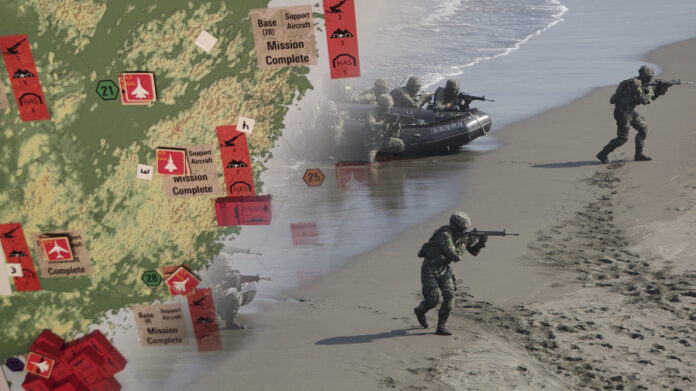
After Speaker Pelosi’s Taipei visit, the CSIS commenced a series of war games to simulate a potential war between the US and China over Taiwan. The US emerged victorious in defending Taiwan, but suffered the losses of 900+ US Navy and Air Force fighters and 2 multi-billion dollar aircraft carriers. How did this happen?!? Let’s find out.
MODERATORS
Various think tank experts, military officers, and college students gathered to simulate the war games.
The game moderators include two doctoral students at MIT, an ex-Marine captain, and Eric Heginbotham. Heginbotham is a principal research scientist at MIT’s CSIS and author of numerous books and articles about China’s military.
The overseer of the war games is Mark Cancian, a CSIS senior advisor and retired Marine colonel.

PARTICIPANTS
The US team included Chris Dougherty and Daniel Rice. Chris Dougherty served as an airborne infantryman of the 75th Ranger Regiment from 1997 to 2000. Now, Dougherty is a senior fellow for the Center for a New American Security’s Defense Program. Daniel Rice is an analyst with The Mitchell Institute for Aerospace Studies.
The China team consisted of Dr. Nora Bensahel and Thomas Greenwood. Dr. Bensahel is a visiting professor at John Hopkins School of Advanced International Studies. Greenwood is a research staff member at the Institute for Defense Analyses.
PRELUDE TO WAR
It is 2026. The United States is caught in another global crisis. This crisis could be a large virus outbreak, direct confrontation between US and Russian troops in Africa, Iranian assaults on Saudi oil fields, etc. Capitalizing off of the crisis, the Chinese military (PLA) proceeds with its plan to invade Taiwan.
In this pessimistic, but realistic, 2026 war game scenario, the PLA conducted a large-scale intelligence operation before the planned assault. This operation is targeted to gather information on Taiwanese routine defense systems (missiles and shore batteries). After months of meticulous planning, the PLA Navy successfully landed 20-30k marines on multiple beachheads across the island. In response, the US, Japan and its allies enter the war.
INITIAL CHINESE SUCCESS
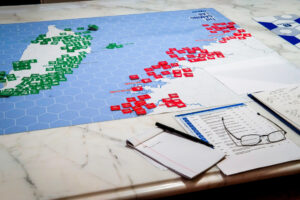
The 22 war games involve two maps with an operational map of the Western Pacific. Each team uses computer models and combat results tables to decide what happens. These decisions are based on analyses of historical experience. Furthermore, dice are used to add an element of randomness.
On China’s first turn, the Chinese PLA Navy lost over 100 ships during the initial marine landings. However, on its first turn, the US team lost an entire aircraft carrier and 700 aircraft due to Chinese missile strikes and aerial battles.
Afterwards, the players move on to a map that simulates China’s ground invasion of Taiwan. Due to the previous success of Chinese military intelligence, Taiwan’s military sustain various naval and missile damage to its batteries.
In most of the 22 war games, a “forest of Chinese ships” envelop Taiwan. In a few other games, the Chinese PLA sunk a US Amphibious Ready Group twice with missiles and fighter jets.
US RESPONSE
After the Chinese invasion, the US gained permission from the Philippines and Japan to house additional Army and Marine divisions, aircraft carriers, and several Air Force squadrons.
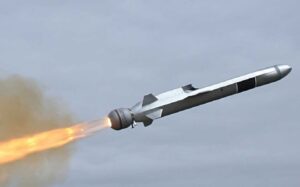
Once arriving in the Philippines, the US Marines install their Naval Strike Missiles throughout the country, including US Naval Base Subic Bay.
Even if the Marines fire numerous NSMs from Subic Bay, the NSMs will only be able to reach its 100-mile limit. The distance from Subic Bay to Taiwan is around 600-700 miles. This complication forced the US to seek longer-range missiles.
The US Navy deployed several aircraft carriers to the South China Sea and Western Pacific. Despite being able to deliver some aerial strikes on the Chinese PLA Army, US aircraft carriers were constantly harassed by enemy aircraft and missiles.
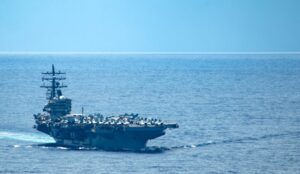
However, the US military was able to overcome Chinese blockades and missile strikes. Also, the US Air Force went on the offensive and commenced various strikes on Chinese ports and bases.
Sustaining several Chinese attacks in the war’s early days, Japan enters the war and deploys dozens of cruisers, frigates, and submarines.
Along with their Japanese counterparts, the US Navy was able to sink dozens of Chinese warships. As one player noted, the Chinese PLA Navy ceased to exist after weeks of devastating US strikes.
US & JAPAN SEAL THE VICTORY
Despite their initial success in establishing beachheads and striking a handful of US ships, the Chinese PLA sustained too many strikes on their ports and supply chains. The US missile strikes slowly began to turn the tide of the wargame.
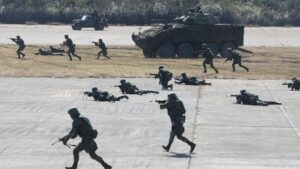
After weeks of struggling to breach the Chinese blockade, the US Navy destroyed dozens of Chinese ships and completely cut off Chinese supply lines to Taiwan. In the simulation, thousands of stranded Chinese troops foraged for food. Overall, the Chinese troops in Taiwan were low on ammunition, subjected to Taiwanese guerilla warfare, and slowly weathered by US paratroopers and Marines.
RESULTS
By the end of the game, the China team lost more than 18,000 troops in Taiwan. In addition, the Chinese PLA Navy lost 51 amphibious ships, 58 major combatant ships, seven Surface Action Groups (3-4 ships each), and hundreds of aircraft (includes advanced J-20s and Sukhoi S-35s).
Meanwhile, the US team sustained several thousand casualties among all branches. Also, the US Navy lost three Surface Action Groups, 900 fighter jets, and two aircraft carriers.
The war games ended before the complete finish of all 22 games. This indicates that the war simulation could get worse. Both the US and China witnessed staggering losses not seen since WWII.
After the war games, Cancian said that “it would be a very different fight when you have to get in close and the attrition goes up further.” Cancian that “we’re going to be throwing rocks at each other” if the “First Sino-American War” is prolonged.
CONCLUSION
Even though the likelihood of a full-scale war between the US and China is low for now, the US military is now looking to improve its ground, naval and aerial capabilities. These capabilities include active carrier groups in various regions, additional air squadrons in Japan and Korea, possible military satellite intervention, etc.
Meanwhile, the Chinese PLA is attempting to enhance their naval and airborne capabilities in case of a swift political decision to invade Taiwan.
Overall, any side’s attack on another’s aircraft carrier or naval vessel could signal a destructive war that could drain both militaries and possibly leave the United States unprepared in a future war. This war could be against a strong adversary such as Russia or Iran.