

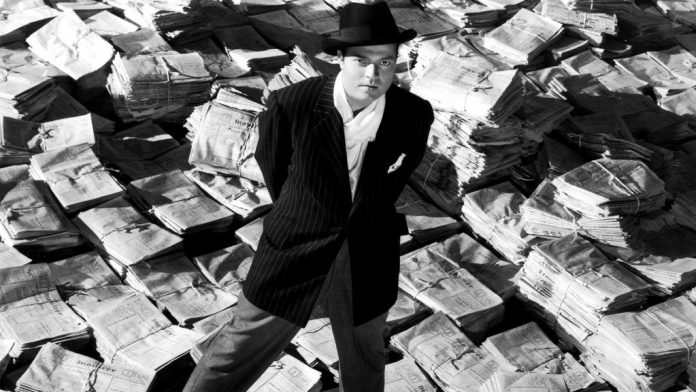
Evidently the leading star in one of the greatest films ever produced was labeled as a Communist before the film was released, so claimed William Randolph Hearst, a newspaper tycoon on which the film is based. Perhaps it was the revolutionary cinematography the creative minds of the movie produced or the plot that kept moviegoers on the edge of their seats that scared Hearst, but all prevailed to create one of cinema’s great masterpieces. In continuum with the running segment entitled “Classic Movie Reviews with Big D,” Citizen Kane claims a spot on my list for one of the greatest cinematic works of all time.
Citizen Kane follows a news reporter’s journey to discover the meaning of a publishing tycoon’s last words. In watching the reporter’s assignment to decipher newspaper magnate Charles Foster Kane’s (Orson Welles) dying words, the fascinating history of a man who rose from insignificance to staggering wealth is gradually revealed to the audience over the course of the film. Though many of Charles’ friends and colleagues such as Jedediah Leland (Joseph Cotten) and mistress Susan Alexander (Dorothy Comingore) shed fragments of light on Kane’s life, the fear of not ever solving the mystery of the man’s final word, “Rosebud,” is what keeps the audience in suspense for the duration of the film.
While many argue Citizen Kane is the greatest film ever made, others have made a strong opposition to this claim. Christopher Horton 18′ had a lot to say about this movie, “Citizen Kane is undeserving of any spot in the top 5, let alone top 500 films ever made. The movie gets way more credit than it deserves and the only enjoyable moment I had when watching the movie was when “The End” appeared on the screen.” Others have found this film to be “overrated” and “overvalued” on lists of the greatest movies ever made. And they aren’t the only ones. At 1941’s Academy Awards the film was booed every time one of its nine nominations was announced. The film was a box-office flop and was quickly consigned to the RKO vaults, only being re-released to the public in the mid-’50s.
Now, many of you may be asking yourself, “Why is this person writing about such a movie?”. The answer to your question is simple: the rich history behind the film combined with its’ entertaining and touching story is simply too overwhelming to ignore. Despite many fans downgrading opinions, critics had wonderful things to say about this film, “Orson Welles’ debut has become an undisputed cultural benchmark – the celluloid equivalent of War and Peace, the Mona Lisa, Hamlet, Moonlight Sonata, or Sergeant Pepper’s Lonely Hearts Club Band (the Beatles album, not the Bee Gees movie).”
Robert Osborne also went on to say “a major reason that so many praise this so highly is because of the black and white cinematography of the man who filmed it, Greg Toland. The cinematography is about the only thing on the film that wasn’t done by Orson Welles. Welles produced the movie, he also co-wrote it, directed it, and stars in it. He was also the first to say he couldn’t have made it without Greg Toland.”
Ultimately, this film is a classic which is deserving of another look and spot on my list of classic movies. Disagree? Leave a comment in the Comments section down below. Stay tuned for another addition to the segment “Classic Movie Reviews with Big D”. Until next time, I’m David Horton and thanks for reading.